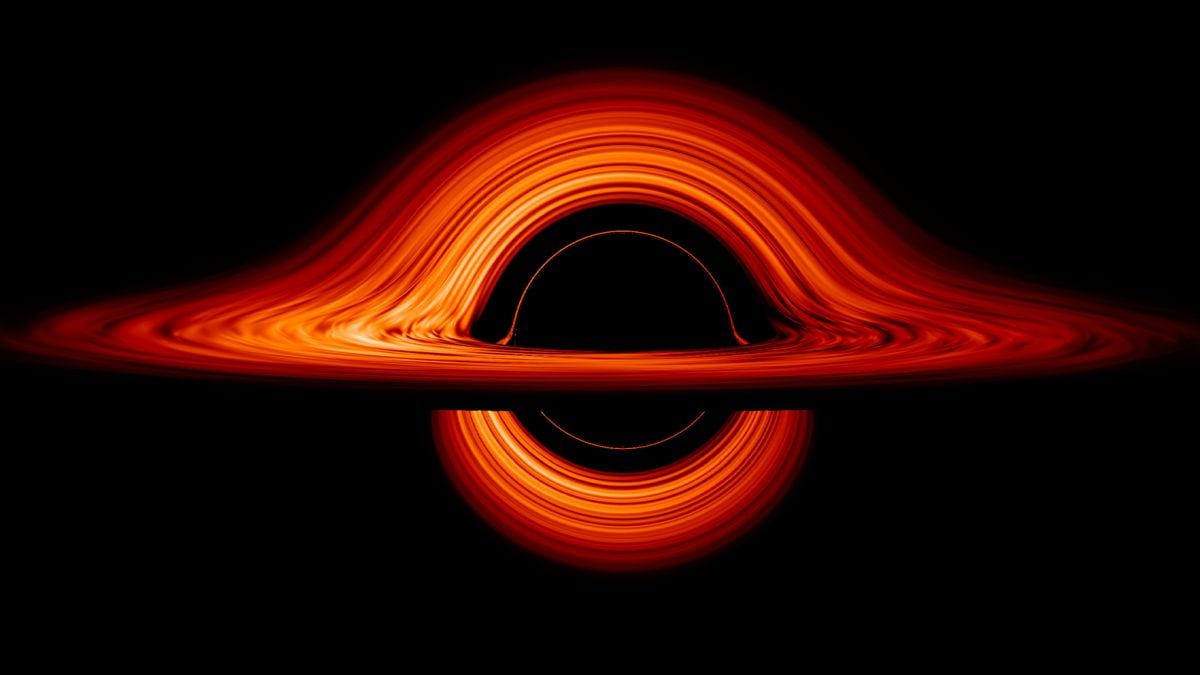
Scientists reported the first observational signature of a black hole event horizon from gravitational-wave event GW250114, using a newly identified 'direct wave' component in the merger signal. The result, published in Nature, could enable more direct measurements of horizon rotation and stronger tests of general relativity, though it still requires validation across additional events. Market impact is likely limited, but the finding is a meaningful scientific advance in black-hole physics and gravitational-wave astronomy.
This is not a direct revenue catalyst for public equities, but it is a meaningful signal for the scientific-instrumentation stack. If the result is validated, the biggest economic beneficiary is the small set of firms with secular leverage to ultra-low-noise sensing, precision timing, vacuum/cryogenic systems, and high-throughput signal processing: the second-order demand comes from detector upgrades, not from astronomy itself. The market is still underpricing how much a credible horizon-level measurement would pull forward capex across the LIGO/Virgo/KAGRA ecosystem and adjacent quantum-sensing programs over the next 2-5 years.
The near-term risk is that this remains a one-off statistical fit rather than a repeatable observable. That matters because the tradeable implication depends on replication: if subsequent events fail to show the same signature, funding agencies will treat this as an interesting proof-of-concept rather than a budget-expanding breakthrough. Conversely, if repeat detections arrive, the narrative shifts from “astrophysics curiosity” to “new measurement regime,” which could justify larger detector budgets and faster procurement cycles for optics, lasers, vibration isolation, and HPC clusters.
The contrarian view is that the first-order opportunity is not in obvious aerospace names but in industrial and semiconductor companies with niche exposure to metrology and photonics. Consensus will likely chase headline science and miss that the real monetization is equipment refresh, not publication prestige. In the meantime, this can also support a mild multiple expansion for AI/HPC vendors that provide the inference and denoising stack used in gravitational-wave analysis, but only if agencies and labs continue scaling datasets rather than declaring victory.
For risk management, the relevant horizon is months to years, not days. The event itself is not a macro hedge; it is a catalyst for a slow-moving funding and procurement cycle. The main reversal would be a failure to replicate, or a shift in scientific consensus that the detected component is an artifact of model selection rather than a new observable.
AI-powered research, real-time alerts, and portfolio analytics for institutional investors.
Request DemoOverall Sentiment
mildly positive
Sentiment Score
0.30
