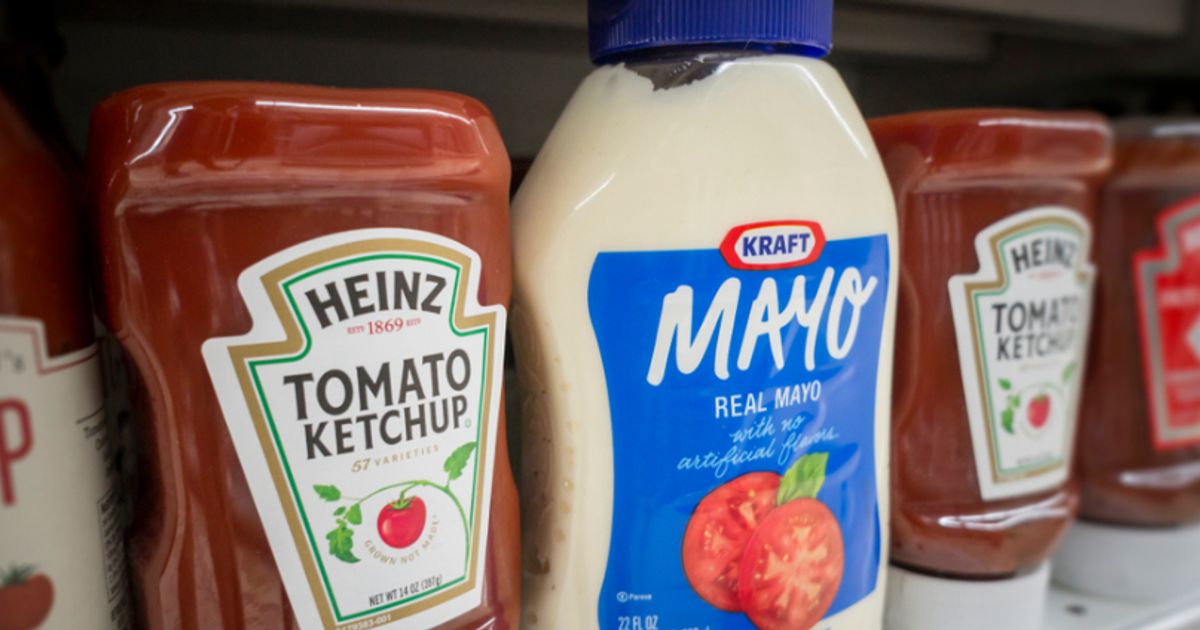
Kraft Heinz reported mixed Q4 results with adjusted EPS of $0.67 beating the $0.61 consensus while revenue of $6.35bn narrowly missed $6.38bn; net sales fell 3.4% (organic down 4.2%) and gross margin contracted ~150 bps to 32.6%. Operating income was $1.1bn (adjusted operating income down 15.9% to $1.2bn), and full-year net sales declined 3.5% to $26bn while adjusted operating income fell 11.5% to $4.7bn; the company recorded a $4.7bn net loss driven by $9.3bn of non-cash impairment charges. Cash flow was a bright spot—net cash from operations rose 6.6% to $4.5bn and free cash flow grew 15.9% to $3.7bn—and the firm returned $2.3bn to shareholders, announced a $600m growth investment, and paused previously planned business separation work to focus resources on profitable growth.
Market structure: Kraft Heinz (KHC) pausing the separation concentrates capital on marketing and pricing initiatives ($600m) while preserving $0–dis-synergy savings this year; winners include private-label and innovation-focused rivals (e.g., GIS, CPB) that can capture share if KHC execution falters, while grocery retailers (WMT, KR) gain short-term negotiating leverage. The 150bp gross-margin hit and -4.2% organic sales imply weaker pricing power in value categories; if Taste Elevation lifts mix by 200–300bp vs. current levels over 6–12 months, KHC can partially restore margin lost from trade spend.
Risk assessment: Near-term tail risks: an adverse retail promotion cycle or another impairment >$3–5bn could trigger credit-rating pressure and a >20% equity downside. Time buckets: days—limited stock reaction; weeks—investor scrutiny of how $600m is allocated; 3–12 months—sales/margin readthroughs and potential activist moves; 12–24 months—valuation impact if separation remains shelved. Hidden dependency: success hinges on retailer shelf economics and promotional ROI; higher A&P can depress margins before consumer payback materializes.
Trade implications: Direct: modest long-equity exposure to KHC is defensible given FCF ($3.7bn) and $2.3bn shareholder returns, but size and risk limits matter. Pair trades and options: favor relative longs in higher-quality staples (GIS) vs. KHC and cash-secured puts to collect premium while targeting entry below $22.50. Sector rotation: trim low-growth staples exposure in favor of premium CPG and selective discretionary names that benefit from premiumization over 6–18 months.
Contrarian angles: Consensus underweights the significance of rising FCF (+15.9%) and buyback capacity as a valuation floor—impairments are non-cash but signal past brand weakness. The market may be underpricing the probability that targeted marketing lifts US organic sales back to flat within 4–6 quarters; conversely, pausing separation raises activism risk that could force a discount-to-NAV rerating if not acted on within 12 months.
AI-powered research, real-time alerts, and portfolio analytics for institutional investors.
Request DemoOverall Sentiment
mixed
Sentiment Score
-0.05
Ticker Sentiment
