





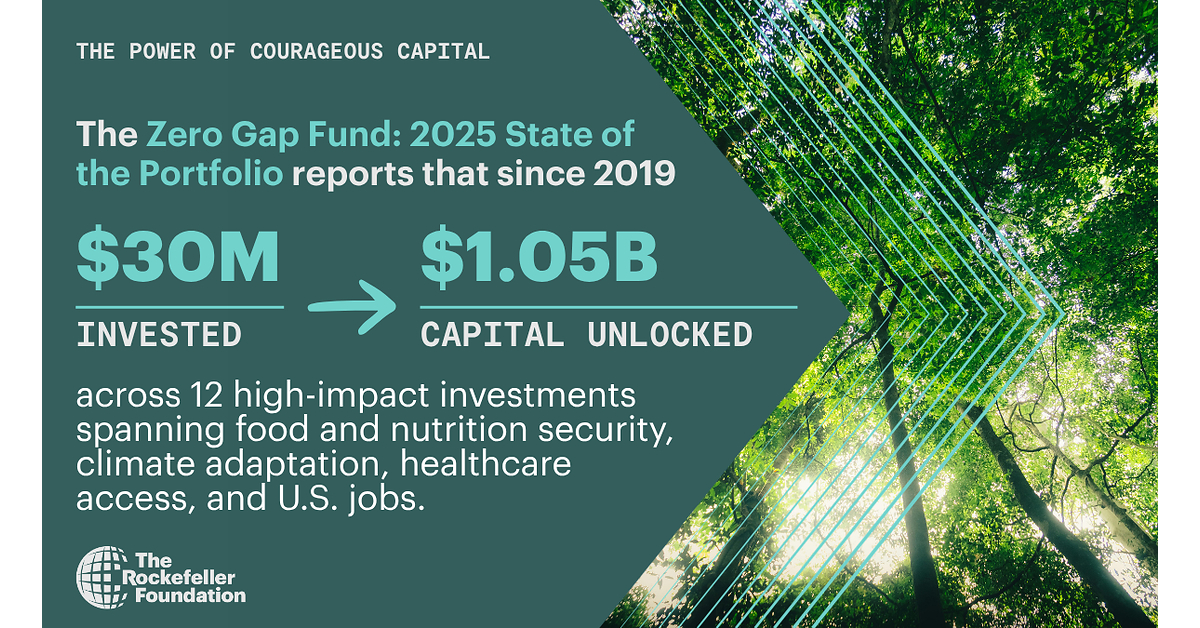
The Rockefeller Foundation-led Zero Gap Fund mobilized $1.05B of private investment against its fully committed $30M catalytic capital since 2019 (about a 35x leverage ratio), supporting 12 SDG-focused investments across sectors including climate adaptation, healthcare access, and U.S. jobs. As of Dec. 2025, $28M of the $30M had been deployed with four exits, and reported outcomes included 173,000 jobs, 361M consumers reached, 28M liters of clean water, and emissions reductions of 2.7M metric tons CO2e. The report frames impact investing as an important bridge as UN-estimated SDG financing gaps rise to more than $4T annually amid ODA cuts.
This is less an earnings event than a signal about who gets paid when capital is scarce: the advantage shifts to managers and financiers that can de-risk projects and monetize blended structures. In public markets, the cleanest beneficiaries are alternative-asset platforms with private credit and structured-finance capabilities; the weak link is any impact sleeve that relies on concessional capital but cannot prove repeatable cash-flow conversion. The real second-order effect is a lower marginal cost of capital for private climate adaptation, SME finance, and ag/food tech, which supports deal flow even if headline GDP conditions stay soft.
The main risk is crowding. As more philanthropic and institutional dollars chase the same “bankable impact” bucket, IRRs can compress even if AUM rises, so the winners are the firms that originate proprietary flow and control underwriting, not the ones buying generic exposure. Over 1-3 months, watch for follow-on fundraising announcements and deployment velocity; over 6-18 months, the question is whether these structures scale beyond a few flagship funds or remain bespoke, subsidy-dependent vehicles.
Contrarian view: the leverage multiple is being treated as if it were a repeatable market law, but it is mostly a backward-looking pool-level outcome. If aid cuts persist, the opportunity set expands, yet the easiest projects are likely already financed; incremental capital may face diminishing returns and more mission drift. The falsifier is simple: if new commitments or exits slow while allocations keep leaning toward lower-yielding de-risked deals, the thesis becomes branding, not investable alpha.
AI-powered research, real-time alerts, and portfolio analytics for institutional investors.
Request TrialOverall Sentiment
mildly positive
Sentiment Score
0.20
Ticker Sentiment
