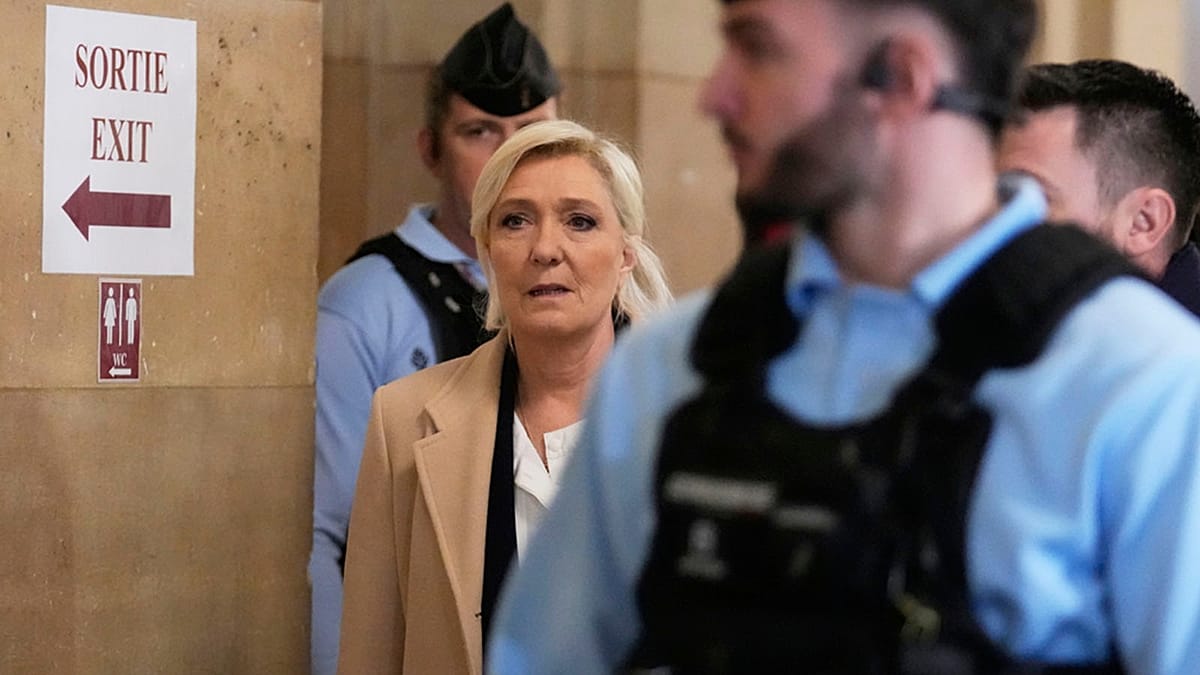
Marine Le Pen said she will not run for France’s 2027 presidency if a court sentences her to wear an electronic bracelet, arguing house arrest would make campaigning impossible. In March 2025 a Paris court found her at the heart of a scheme that siphoned €2.9 million in EU Parliament funds and imposed a five-year ban from public office; the appeal trial concluded on 11 February and an appeals verdict is scheduled for 7 July. If the appeals court upholds the sentence she would be barred from running and National Rally vice-president Jordan Bardella — who polls suggest would win the 2027 runoff — would likely become the party’s standard-bearer, increasing political uncertainty ahead of the election as President Macron is term-limited.
Market structure: A credible risk that Marine Le Pen is barred (verdict set for 7 July) raises political-risk premia in France: short-term losers include French sovereigns and domestically exposed stocks (banks, retail, regional utilities) while defensives (Bunds, gold) and euro-hedged exporters may benefit. If RN leadership transitions to Jordan Bardella with sustained RN strength, policy risks (protectionism, fiscal looseness) could lift bond yields by 10–50bps vs Bunds and compress bank valuations via deposit/repricing uncertainty.
Risk assessment: Tail risks include large-scale social unrest, EU sanctions, or a snap realignment of EU fiscal rules that would sharply widen French 10y spreads (>50bps) and trigger 1–3% EURUSD moves; probability low but impact high. Near-term (days–weeks) volatility will cluster around 7 July; medium-term (3–12 months) depends on polling momentum and party cohesion; long-term (1–3 years) on enacted policy if RN governs.
Trade implications: Tactical trades should be short France risk and long hedges: FX short EURUSD, buy French sovereign protection or underweight EWQ, and favor pan-European exporters/defensives and defense/industrial names that gain from security-nationalist agendas. Use options to cap downside around the verdict window and prefer relative-value shorts in French banks vs German peers to exploit sovereign–bank linkage.
Contrarian angles: Markets often overreact to French political noise; 2017 and 2022 shocks were transient—if verdict simply sidelines Le Pen but RN remains electorally viable under Bardella, the structural policy shock may be smaller than priced. A ban could paradoxically unify RN voters or pressure moderates into coalition, reducing realized market disruption; size positions accordingly and scale out post-verdict if volatility abates.
AI-powered research, real-time alerts, and portfolio analytics for institutional investors.
Request TrialOverall Sentiment
neutral
Sentiment Score
-0.10
