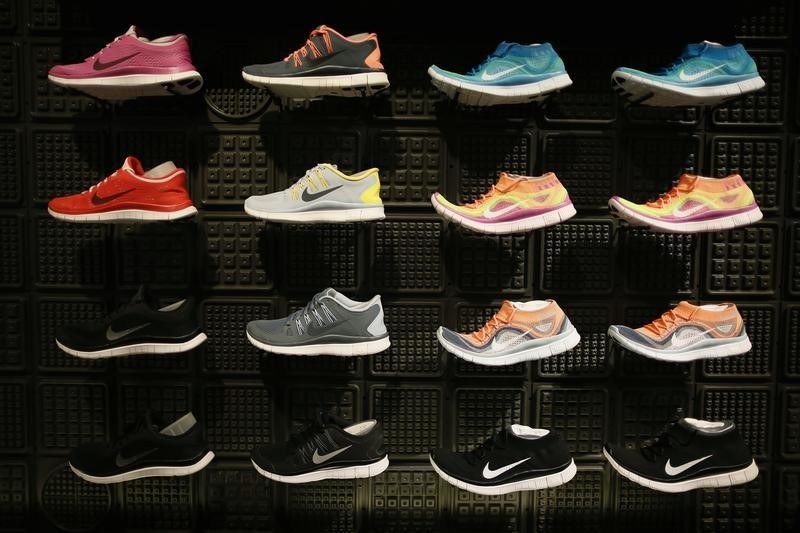
Stifel maintained a Hold on Nike with a $65 price target while the stock trades at $53.38 (near its 52-week low of $52.28); Stifel sees limited upside but expects Q4 fiscal 2026 guidance to top Street estimates of $11.3B revenue and $0.24 EPS and projects a long-term ~12% operating margin with a 100bp China headwind. Street Q3 fiscal 2026 estimates cited are ~$11.2B revenue and $0.30 EPS (BTIG models $11.28B/$0.26); BTIG cut its PT to $90 from $100 and UBS trimmed its PT to $58 from $62 (Neutral), while Jefferies reiterated a $110 Buy on signs of wholesale recovery and strong running-shoe demand. Nike reports earnings March 31; the mix of downgrades and one bullish call creates an unclear near-term catalyst for shares.
Near-term investor focus is binary: channel-level proof points (DTC membership, wholesale inventory turns, and sell-through by retail cohort) will drive re-rating more than headline revenue. If DTC metrics improve while wholesale inventory normalizes, margins can expand quickly because fixed-cost leverage and skinnier promotional cadence compound; conversely, a reversion toward heavy wholesale promotions would compress margins faster than top-line growth can bail out.
Competitive dynamics favor brands that can flex assortment cadence and geographic marketing spend; that raises the value of owned-retail and membership data as a moat. Regional share shifts force incremental SG&A and product localization in Greater China, which is a slow bleed on operating margin unless offset by higher price realization or lower product costs over 12–24 months.
Second-order supply-chain effects are asymmetric: order pullbacks ripple to contract factories and input suppliers within 2-3 quarters, creating optionality in logistics and raw-material names but also haircuts to working-capital requirements for the brand. Watch factory lead-times and airfreight bookings as a near-real-time inventory barometer — improvements there precede clean wholesale restocking.
Key catalysts to watch are post-earnings guidance tone, membership engagement metrics, and retailer inventory disclosures over the next 1–3 months; these will determine whether to pivot from a liquidity-driven trade to a structural-margin trade. The consensus is underweighting the speed at which a favorable product cycle (one hit sneaker) can re-accelerate owned-retail conversion and compress promotional reliance, making this a conditional but high-conviction event trade window.
AI-powered research, real-time alerts, and portfolio analytics for institutional investors.
Request DemoOverall Sentiment
mixed
Sentiment Score
0.00
Ticker Sentiment
