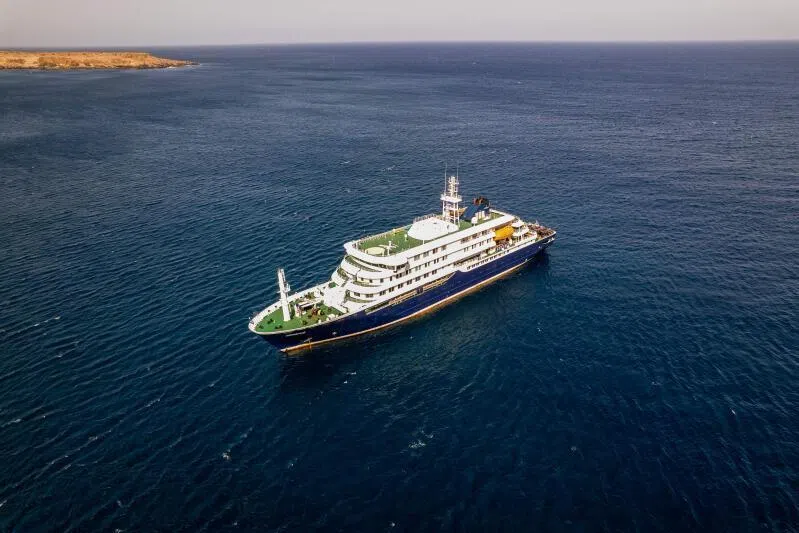
The most market-relevant development is the Strait of Hormuz crisis, with the US saying it will soon escort ships through the blocked waterway while talks with Iran continue. The article also notes a WHO-confirmed hantavirus outbreak on a cruise ship with 3 deaths and 5 additional suspected cases, plus Britain’s move toward talks with the EU on a £78 billion ($135 billion) Ukraine loan. The F1 story is positive for Mercedes and Kimi Antonelli, but it is mainly sports news and unlikely to have broad market impact.
The key market read is that the Strait of Hormuz risk is transitioning from a binary supply shock to an operational drag on global trade. Even a partial escort regime tends to widen freight, insurance, and war-risk premia before any physical interruption shows up in energy balances, which means the first beneficiaries are not just upstream energy names but also marine insurers, defense logistics, and select tanker owners with insured capacity. The second-order loser is the Asian import complex: refiners, chemical margins, and eventually airlines/smaller industrials in Japan, Korea, India, and China should feel the pain before US consumers do.
The more interesting setup is that diplomacy can dampen spot panic while leaving term-risk elevated. That creates a classic “volatility up, direction uncertain” regime where crude may fail to trend cleanly but energy equities can still outperform because the market prices in higher realized volatility and optionality on disruption. If the escort effort turns into a rolling convoy model, expect a persistent floor under shipping rates for weeks, not days, and a broad repricing of security-sensitive routes rather than a one-off spike.
On the defense side, Europe’s willingness to co-fund Ukraine support with Britain in the loop is a structural signal, not a headline trade. It implies incremental fiscal durability for European air defense, munitions, EW, and logistics primes over a 6-18 month horizon, while also reducing the probability that any one US policy reversal fully collapses support. The contrarian point is that this is not a generic “buy defense” headline; the better setup is for suppliers with constrained production capacity and visible order books, because margin expansion comes from scarcity, not just top-line growth.
Health/travel risk from the cruise outbreak is economically small in isolation, but it reinforces that the leisure complex remains vulnerable to abrupt demand shocks from biosafety headlines. That matters most for operators with heavy exposure to expedition cruising or group travel insurance rather than the broad travel basket. For autos, the F1 result is mostly sentiment noise, but it does support a broader read that Mercedes’ competitive cadence is improving faster than consensus, which may matter for supplier names tied to powertrain, aero, and high-performance software if this translates into sustained fan engagement and sponsorship pull.
AI-powered research, real-time alerts, and portfolio analytics for institutional investors.
Request DemoOverall Sentiment
neutral
Sentiment Score
-0.05
