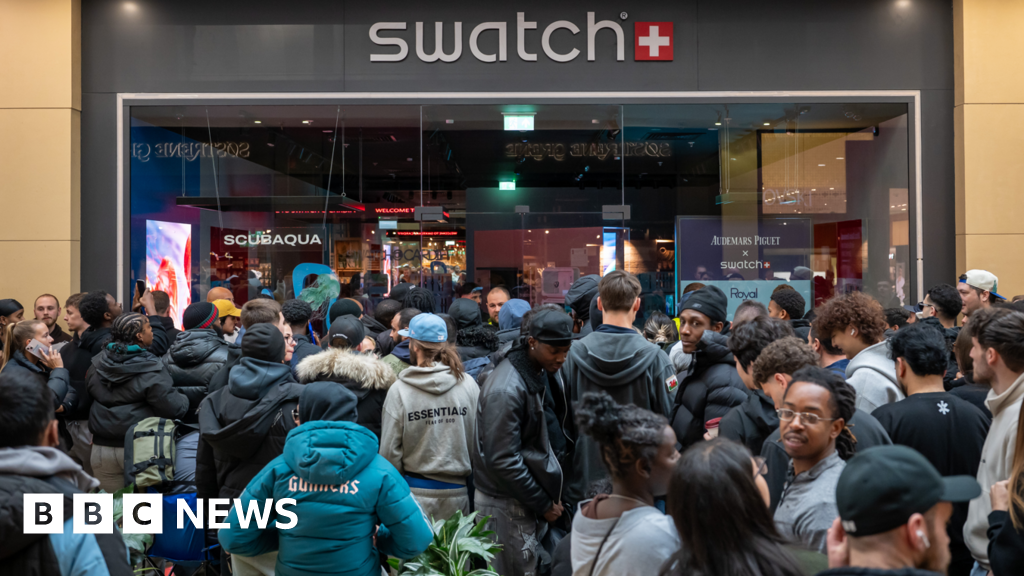
Swatch closed stores in Manchester, Liverpool and other UK cities for a second day after crowds formed around the launch of its new £335 Royal Pop pocket watch collaboration with Audemars Piguet. The company said queues of more than 50 people could not be accepted and sales may be paused for safety reasons, while some launches were disrupted in Cardiff, Dubai, France, Switzerland and New York. Demand appears strong, but the operational handling created public-safety concerns and criticism over launch management.
The immediate economic signal is not scarcity-driven demand, but a proof-of-concept that this collaboration can generate cultural heat disproportionate to its price point. That matters because luxury/watch brands increasingly rely on scarcity mechanics to defend pricing power; when the secondary market prints 40x-50x the retail price, it validates the halo effect even if conversion at launch is messy. The near-term beneficiary is probably Audemars Piguet more than Swatch: AP gains visibility into a younger, broader audience without needing to discount its core brand, while Swatch absorbs the operational and reputational friction.
The second-order risk is governance, not demand. If management repeatedly allows launch chaos, investors will start marking down execution quality across future collaborations and limited releases, especially if police and store-closing headlines become a recurring pattern. That can compress the multiple on “brand-driven optionality” because the market will distinguish between monetizable scarcity and amateur event management; the former supports margin expansion, the latter raises legal, staffing, and insurance costs.
For competitors, the event reinforces that controlled drops and waitlist economics remain effective in discretionary luxury, which is positive for names with stronger e-commerce gating and CRM infrastructure. The uncomfortable contrarian point is that the resale frenzy may be bullish for brand equity but bearish for near-term direct sales if consumers view retail access as unfair or unsafe; that shifts value to resellers and social platforms rather than the issuer. Over 1-3 months, the key question is whether this becomes a one-off marketing win or a template for more disciplined online allocation.
AI-powered research, real-time alerts, and portfolio analytics for institutional investors.
Request DemoOverall Sentiment
mildly negative
Sentiment Score
-0.10
