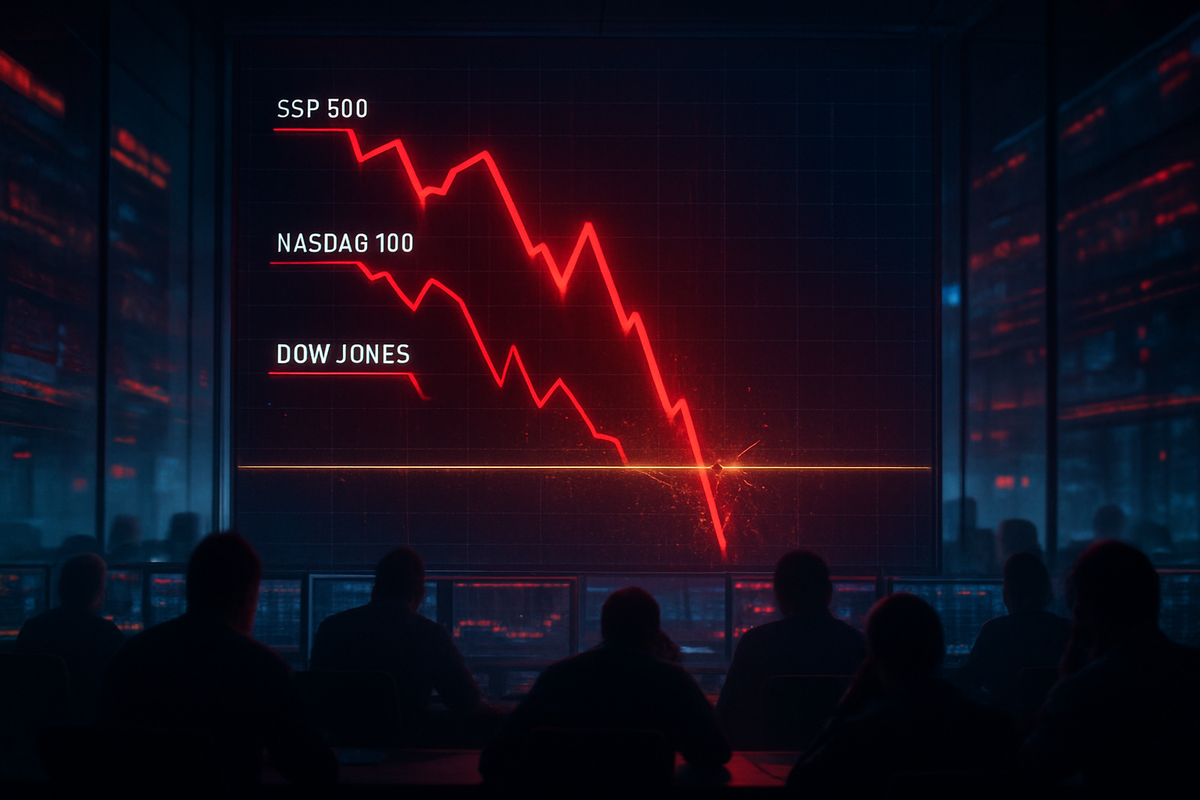
The S&P 500, Nasdaq 100 and Dow all closed below their 200-day moving averages in a synchronized 'triple breach' on March 19, 2026 (S&P 500 at 6,589 vs 200-DMA 6,618). NYSE volume was ~40% above the 30-day average amid algorithmic panic-selling; Nvidia traded near $175, below its 200-DMA of $177.85, reflecting roughly $90bn YTD market-cap loss for NVDA. The sell-off was driven by a U.S.–Iran maritime standoff that pushed Brent toward ~$116/bbl, renewed stagflation fears and hawkish Fed rhetoric, raising the risk of a broader multi-month bear market and potential 'Death Cross' formation by mid-April for the Nasdaq 100.
Market structure, not fundamentals, is the accelerant today: cross-asset margining, dealer gamma hedging in short-dated options, and passive-cap index mechanics can transform a technical signal into tens of billions of liquidity demand in hours. That cascade tends to hit the most concentrated market weights first and then propagates into nominally uncorrelated pockets via funding and collateral channels, creating volatile, intraday mismatches between cash and futures liquidity.
Macro tail risks are asymmetric over the next 1-6 months. A sustained energy-price regime that keeps core inflation above the Fed’s tolerance window will lock in tighter real rates and pressure rate-sensitive growth assets; conversely, a clear de-escalation in the geopolitical flashpoint or a rapid decline in oil over 4-8 weeks could produce a violent, short-covering rally as volatility sellers are forced to rebalance. Regulatory interventions around ultra-short-dated options or exchange halts are non-linear event risks that could either calm dealer inventories or further dislocate price discovery.
Given the regime shift to ‘‘sell the rip’’ and higher realized volatility, priority should be capital preservation, tactical volatility exposure, and asymmetric pairings that short concentration while owning cash-flow positive cyclicals. The market will reward assets with visible free cash flow and pricing power; we should size positions for directional risk but favor structured/defined-risk implementations to survive whipsaw windows over the next 3 months.
AI-powered research, real-time alerts, and portfolio analytics for institutional investors.
Overall Sentiment
strongly negative
Sentiment Score
-0.80
