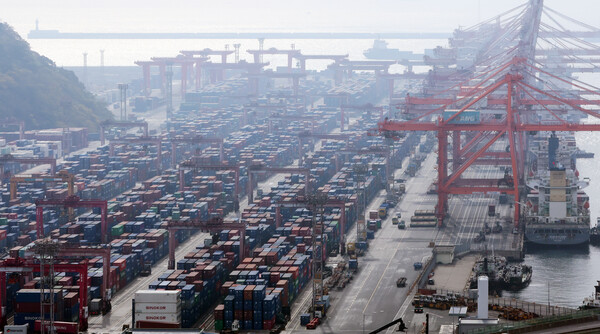
South Korea's Bank of Korea raised 2025 GDP growth to 2.6% from 2.0% and lifted next year's forecast to 2.1%, while also increasing inflation 전망 to 2.7% from 2.2% due to higher oil prices. The article is broadly constructive for the export-led economy, highlighting strong second-half demand in semiconductors, defense, shipbuilding and power equipment, with exports potentially topping $900 billion. Geopolitical tensions are a headwind, but current account strength and resilient industrial demand are expected to support the won and offset external shocks.
The market is starting to price South Korea less as a cyclical beta trade and more as a constrained-capacity export compounder. The key second-order effect is that these four sectors are reinforcing each other: semis lift the current account and won, defense and shipbuilding extend order visibility, and power equipment benefits from a multi-year grid capex wave. That combination reduces the usual downside from oil-driven inflation because higher energy costs are now being offset by higher-value export mix rather than just depressing consumer demand.
The most interesting dynamic is that the winners are not just the obvious large caps; the bottlenecks sit deeper in the supply chain. In semis, cautious capex means equipment, specialty materials, and test/packaging capacity can stay tight even if headline memory pricing cools, so the earnings persistence may be broader than the market expects. In defense and shipbuilding, the real scarcity is qualified production slots and export certification, which means order conversion should favor firms with existing Western references and production backlogs over pure “new order” names.
The main risk is that this is a duration trade disguised as a cyclical trade. If oil spikes further or Middle East shipping risk broadens, the won may not strengthen as quickly as expected, and the BOK could stay more hawkish for longer than equity investors want. A second-order negative is valuation compression if the market starts treating these stocks as crowded beneficiaries of geopolitics and AI infrastructure, especially once backlog visibility becomes consensus rather than an edge.
Contrarian view: the article may understate how much of the upside is already embedded in forward estimates for the most obvious semiconductor and defense proxies. The better risk/reward may be in the enabling infrastructure names—transformers, grid hardware, advanced manufacturing suppliers, and select industrials tied to export capacity—because they can still surprise on margins without requiring a perfect geopolitical backdrop. The cleanest tell over the next 1-3 months is whether order backlogs and FX move together; if the won lags despite strong exports, that would indicate the market is still underpricing external shock risk rather than overpricing growth.
AI-powered research, real-time alerts, and portfolio analytics for institutional investors.
Request DemoOverall Sentiment
moderately positive
Sentiment Score
0.62
