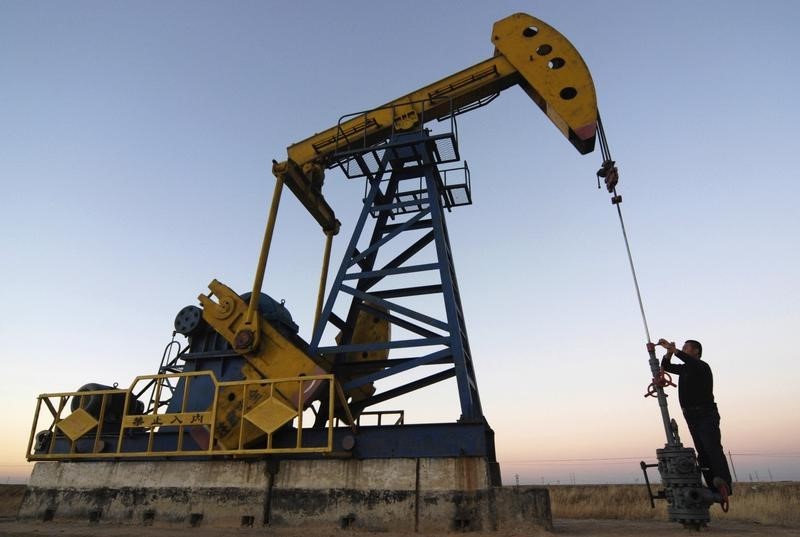
Brent futures jumped as much as 3% to $106.50 and were trading up 1.6% at $104.77/bbl after the U.S. struck Kharg Island and Iran retaliated, effectively blocking the Strait of Hormuz which handles at least 20% of global oil flows. WSJ reports the Trump administration will unveil a coalition this week to escort ships through the strait; prolonged disruption to exports poses a material upside risk to crude prices and broader market volatility.
Near-term energy volatility now behaves like a supply-shock event plus a war-risk premium: front-month crude realized vol typically rises 40–70% and the futures curve steepens into backwardation, rewarding physical storage holders and short-dated call buyers. Shipping and bunker-cost shocks are concentrated on marginal barrels that must take longer routes or transship; a 10–15% increase in voyage distance translates to ~2–4% incremental fuel burn per voyage and creates localized refinery feedstock tightness for 1–3 months.
Defense and maritime-security economics are the clearest incumbency gains — incremental naval deployments and convoy operations shift budgeted operational spend into maintenance, logistics, and service contracts, creating 6–18 month forward revenue visibility for a subset of suppliers. Conversely, demand elasticity for refined products will start to bite if refined-fuel pump prices move persistently above breakpoints (~$4.50–5.00/gal equivalent), producing a negative feedback loop on crude within 2–4 quarters through reduced transport and industrial activity.
Catalysts that will reprice risk fast are: coordinated strategic petroleum releases and an internationally recognized safe-passage mechanism (days–weeks), which would compress the war-premium; and an escalation that causes insurance underwriters to reclassify regional risk levels (weeks–months), which could structurally raise freight and refinery feed costs. The consensus is positioning for a protracted disruption; the contrarian path — temporary insurance arbitrage combined with spare production coming online and policy backstops — keeps a hard cap on upside beyond near-term spikes.
AI-powered research, real-time alerts, and portfolio analytics for institutional investors.
Overall Sentiment
strongly negative
Sentiment Score
-0.60
