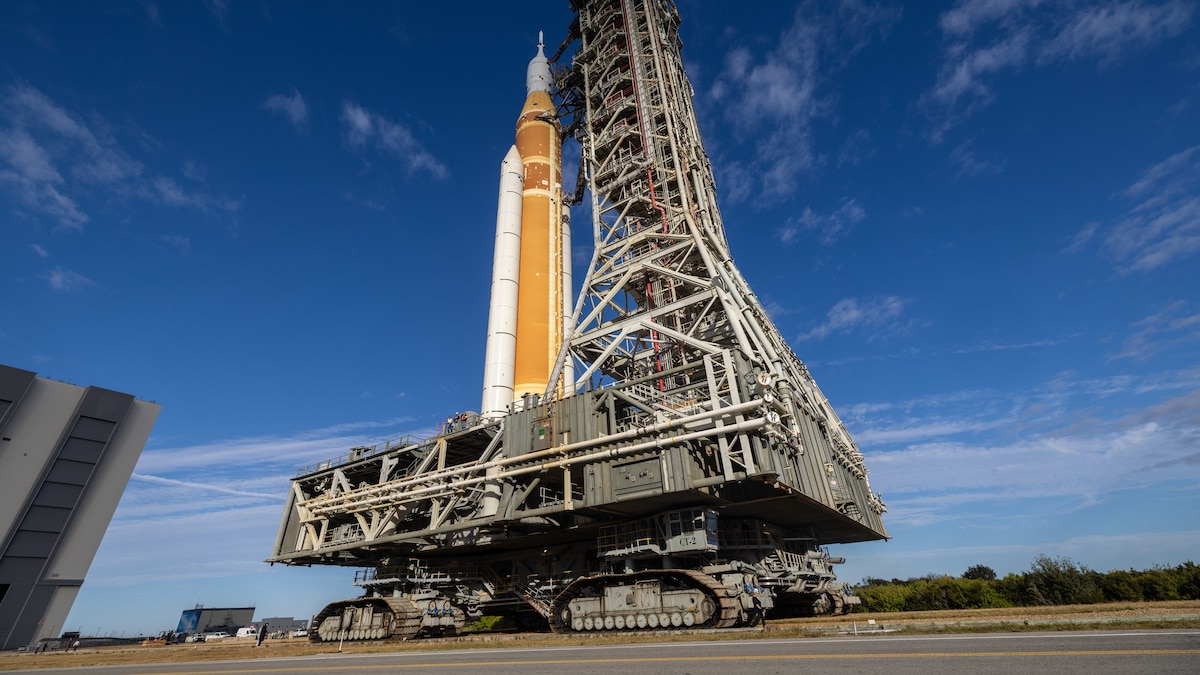
NASA completed the rollout of Artemis II—Orion crew capsule on top of the SLS rocket (322 ft tall, ≈3.5 million pounds)—from VAB High Bay 3 to Launch Pad 39B, a 4.2-mile, ~12-hour transfer using upgraded Crawler-Transporter 2 (6.65 million lb) that moved roughly 15 million pounds of hardware. The operation included CT-2 upgrades (engine refurbishments, new generators, monitoring systems, redesigned brakes), precision laser alignment and computer leveling, and clears a key milestone ahead of a Feb. 6 launch window for a spring lunar flyby, signaling execution progress and schedule confidence for NASA and its contractors with modest positive implications for ground‑services and aerospace suppliers.
Market structure: Artemis II rollout crystallizes incremental revenue visibility for large defense/aerospace primes (Lockheed [LMT], Northrop [NOC], Boeing [BA]) and specialist suppliers (Aerojet Rocketdyne [AJRD]). Near-term winners are primes with fixed-price NASA contracts and heavy-engineering capabilities; losers are small-tier suppliers with single-source dependencies and commercial aviation-exposed firms if capital is reallocated. Modest impact on rates/FX/commodities: expect negligible sovereign yield moves, slight knee‑jerk rise in supplier credit spreads (5–25bp) and a 1–3% bump in implied vols on aerospace names around the Feb 6 launch window.
Risk assessment: Tail risks include launch failure or human-casualty event (low probability, high impact) that could trigger contract reviews, 6–18 month program schedule slips, and political appropriations risk tied to FY2027 budgeting. Immediate horizon (days): volatility spikes into launch (Feb 6); short-term (weeks/months): news-driven repricing around telemetry/rehearsals; long-term (quarters/years): sustained NASA/DoD budget flows if Artemis program scales. Hidden dependencies: single-source RL10/RS-25 engine supply chains, specialized infrastructure (VAB/CT-2) and heavy-equipment OEM health; catalysts are successful launch, GAO audits, and appropriations votes.
Trade implications: Tactical longs: overweight LMT and NOC (defense-prime cashflow, backlog >$Xbn) with 6–12 month targets +12–18%; pair trade: long LMT vs short BA to isolate defense upside vs commercial cyclical risk. Options: purchase 9–12 month call spreads on NOC or AJRD to cap premium ahead of calendarized events. Rotate into industrials/steel suppliers only if FY2027 NASA appropriations increase >5% YoY; reduce airline exposure by 2–4%.
AI-powered research, real-time alerts, and portfolio analytics for institutional investors.
Request DemoOverall Sentiment
mildly positive
Sentiment Score
0.25
Ticker Sentiment
Contrarian angles: Consensus understates multi-year budget tailwinds—if two successful Artemis missions occur in 12–24 months, primes could see sustained contract expansion; conversely the market may overprice short-term celebrations with limited EPS impact. Historical parallel: post‑Apollo supplier consolidation preceded multi‑year contract windfalls, but also created winners who out-invested rivals. Unintended consequence: political pressure to favor commercial launch providers (SpaceX) could shift future awards away from traditional primes, so size positions accordingly.
