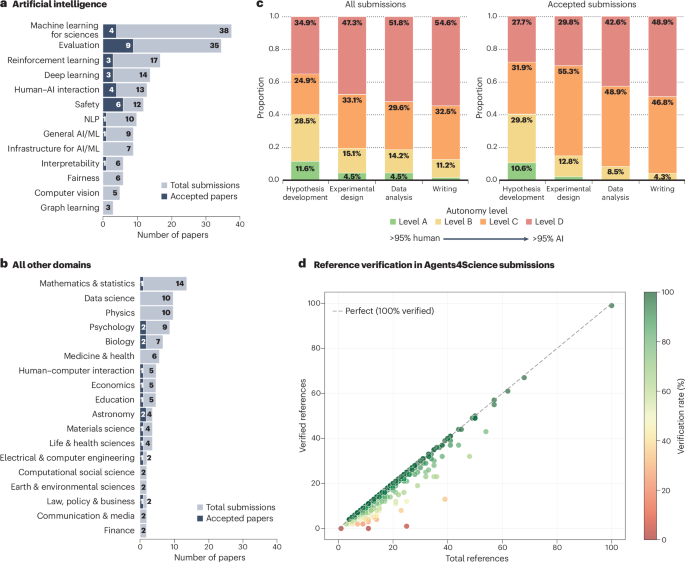
Bianchi et al. (Nature Biotechnology, 2025) report on the Agents4Science conference that examined the use of AI agents as authors and reviewers in scientific research and publishing, compiling conference outputs, related preprints and ethical considerations; the authors declare no competing interests. The paper signals accelerating integration of AI into biotech research workflows and peer review, with potential downstream implications for research dissemination, governance, IP management and regulatory oversight that investors in biotech publishing and research services should monitor.
Market structure: AI-assisted authorship and peer review shift economic rents to compute and platform owners (NVIDIA NVDA, AMD, cloud: MSFT, GOOGL, AMZN). Academic publishers and small editorial-services firms face margin pressure as automated workflows reduce review latency and content gating; expect 10–30% margin compression for legacy publishers over 12–24 months unless they add platform fees. Data providers and specialized scientific-model vendors will see demand growth of +30–50% for labeled datasets and validation tooling over 12 months.
Risk assessment: Key tail risks include rapid regulatory pushback on AI attribution or disclosure (policy changes within 3–18 months) and high-profile reproducibility failures that trigger liability suits for AI-generated findings. Hidden dependencies: availability of advanced GPUs (NVDA/TSMC supply concentration), and proprietary training datasets — outages or embargoes could halt adoption. Catalysts: a major validated drug lead discovered with AI could accelerate buying across biotech/tech within 6–12 months; conversely a retraction could trigger a cyclical derating of small-cap AI-biotech by 25–50%.
Trade implications: Direct plays — overweight NVDA (compute), MSFT/GOOGL (cloud + tooling), and specialist CRO/analytics IQVIA (IQV) for outsourced validation services; underweight legacy academic publishers (John Wiley WLY, RELX REL.L) and small-cap AI-biotech researchers lacking data moats. Use call spreads on NVDA 6–12 month expiries to express upside while funding risk. Rebalance into CROs and cloud names if NVDA pullback >15%.
Contrarian angles: Consensus underestimates concentration risk — a TSMC/NVDA supply hiccup would disproportionally hurt AI-enabled R&D, creating tactical buys in second-tier GPU/FPGA plays (AMD) and on-prem HPC vendors. The market may also over-penalize publishers; a pragmatic winner could be RELX if it bundles AI validation services — consider event-driven long if they announce platform monetization. Historical parallel: early genomics tools saw platform incumbents capture most value after an initial fragmented winners' list.
AI-powered research, real-time alerts, and portfolio analytics for institutional investors.
Request DemoOverall Sentiment
neutral
Sentiment Score
0.00
