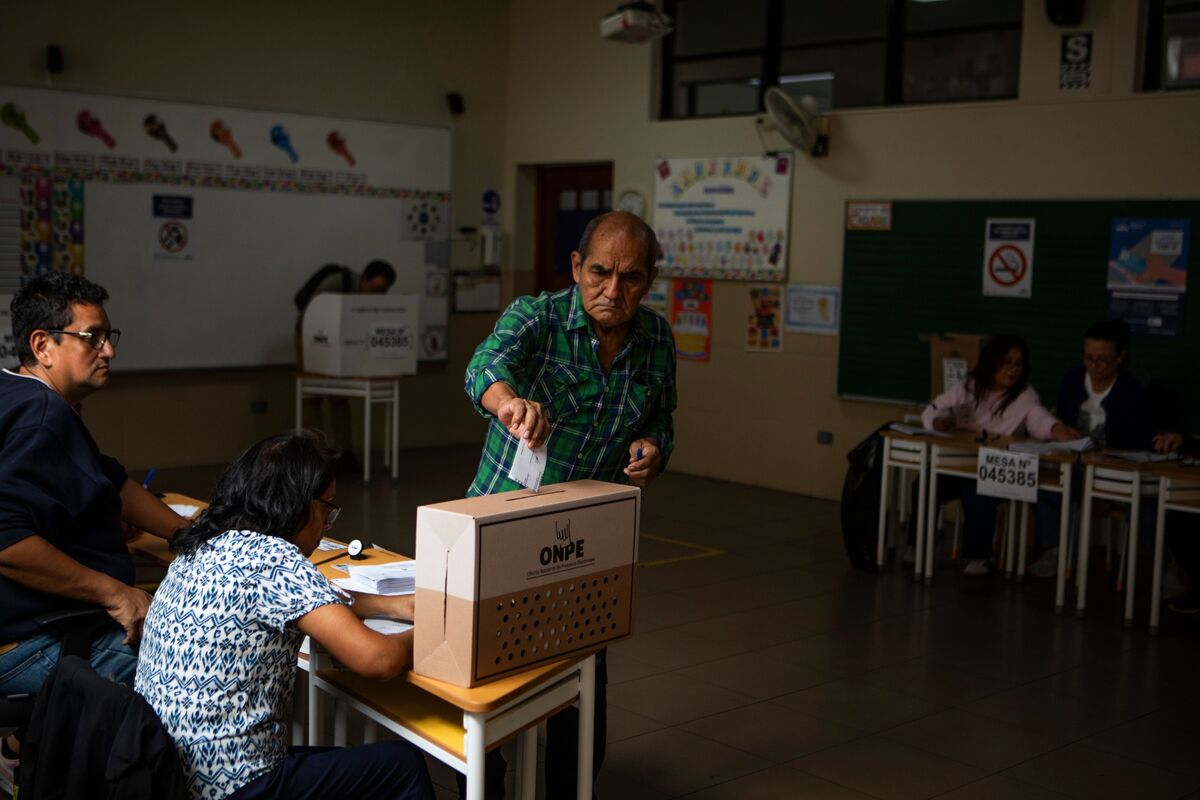
Peru’s presidential race has shifted to election courts, with as many as 400,000 ballots disputed after Keiko Fujimori moved ahead by a few thousand votes. The flagged ballots are mostly tied to minor irregularities such as illegible handwriting, missing signatures, and stains, and are concentrated in Lima, Callao, and overseas voting. The article points to political and legal uncertainty rather than a clear economic or market-moving event.
The immediate market implication is not directional Peru risk, but a volatility premium around any asset tied to domestic policy continuity. When the margin is this thin and the outcome depends on adjudication rather than vote count, the first-order trade is usually in bank funding costs, local credit spreads, and the FX forward curve rather than outright equities. The market will price a higher probability of delayed cabinet formation, weaker implementation capacity, and a slower reopening of capital expenditure decisions over the next 2-6 weeks.
Second-order, Fujimori’s lead in urban and overseas ballots suggests the result may be more durable than a simple recount story, but the legal process itself can still become the macro shock. If the courts validate the lead, expect a relief rally concentrated in financials, consumer discretionary, and construction proxies; if they invalidate enough ballots to flip the outcome, the bigger loser is likely the entire Peru risk basket because the signal becomes institutional fragility, not just political turnover. That tends to widen sovereign and quasi-sovereign funding spreads for months, especially if the opposition contest extends the timeline beyond the inauguration window.
The contrarian view is that the market may be overestimating policy whiplash. A market-friendly winner in a fragmented system can still fail to pass meaningful reform, so the upside in local assets after validation may be capped. The cleaner edge is to trade the uncertainty itself: near-dated volatility and event risk should decay sharply once courts finish, but the tail risk of a prolonged dispute is asymmetric to the downside if social protests or cabinet defections emerge.
AI-powered research, real-time alerts, and portfolio analytics for institutional investors.
Request DemoOverall Sentiment
neutral
Sentiment Score
-0.05
