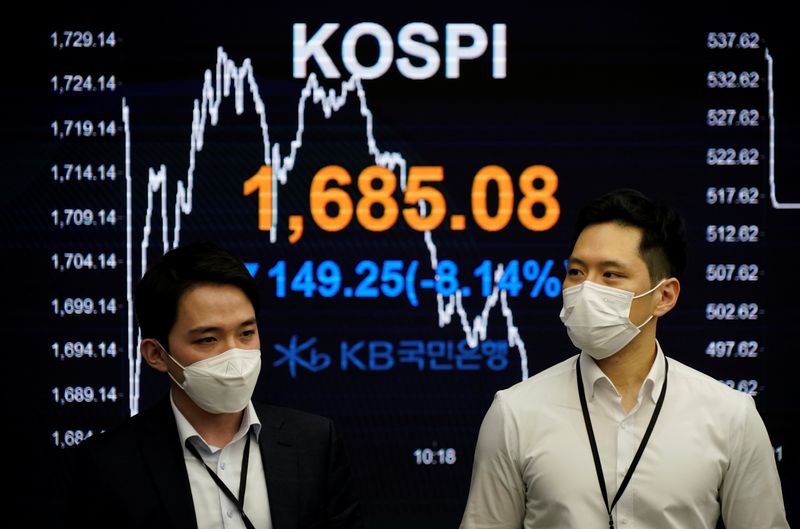
South Korea's KOSPI plunged as much as 8.8% and triggered a Level 1 circuit breaker after a global semiconductor selloff and renewed Middle East conflict pushed investors out of risk assets. U.S. chip stocks tumbled Friday, with the Philadelphia Semiconductor Index down more than 10%, while Samsung Electronics and SK Hynix led losses in Seoul. Iran's missile attack on Israel added to concerns over global growth, inflation, and energy prices, overwhelming Nvidia's new AI partnership announcements in South Korea.
This is a classic cross-asset de-grossing event where the initial catalyst matters less than the positioning backdrop. The semiconductor complex was already crowded on AI capex extrapolation, so any disappointment in forward demand guidance creates a reflexive unwind that spills into the broader Korea beta trade. The circuit breaker suggests forced selling, not just discretionary risk reduction, which usually extends the damage for 1-3 sessions before bargain hunters stabilize the tape.
The more important second-order effect is that geopolitics and AI are now pulling in opposite directions for the same market. Names tied to AI infrastructure can still underperform if they sit inside a macro basket being derisked, while suppliers with direct exposure to memory and advanced packaging face a sharper earnings multiple compression than their long-term fundamentals justify. In other words, the market is likely over-penalizing near-term Korea semiconductor earnings power while underpricing the duration of a higher energy price regime that worsens global inflation prints and keeps rate-cut expectations fragile.
On the energy side, a geopolitical spike is usually a fast money trade unless it broadens into shipping disruption or retaliation against regional infrastructure. The key swing factor over days is whether crude holds its initial gap; over weeks, the risk is that a stable supply response and fading headline intensity pull oil back down, invalidating the inflation scare. If that happens, the current risk-off move in semis could reverse faster than energy does, creating a strong relative-value opportunity.
The contrarian read is that the AI partnership announcements may be providing better medium-term signal than the market is giving credit for: if capex localization accelerates, Korean suppliers could emerge as structural winners even if the equity basket remains volatile. The setup argues for separating price action from fundamentals and buying the most liquid dislocations rather than chasing broad index exposure.
AI-powered research, real-time alerts, and portfolio analytics for institutional investors.
Request DemoOverall Sentiment
strongly negative
Sentiment Score
-0.78
Ticker Sentiment
