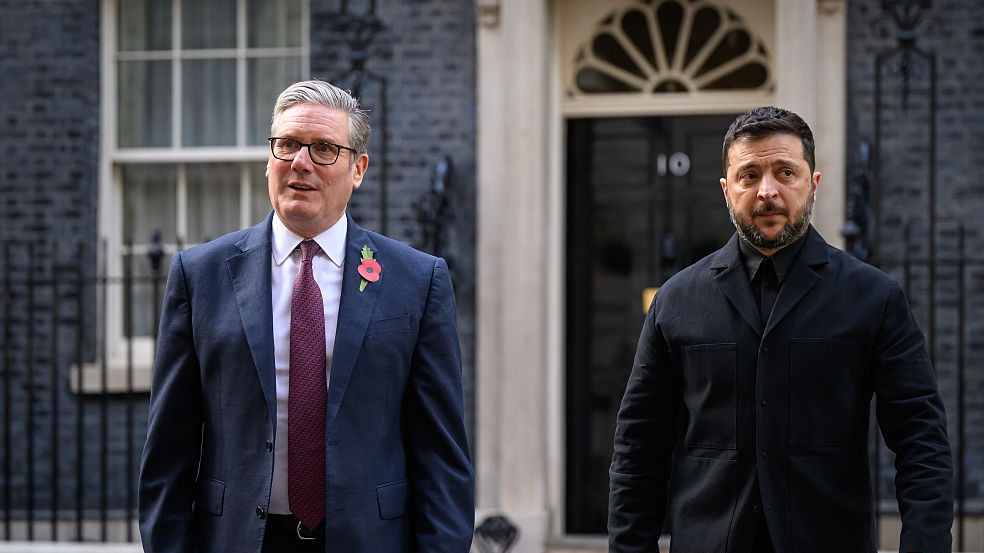
UK Prime Minister Keir Starmer is convening European leaders including Macron, Merz and Zelenskiy in London to discuss security arrangements and the fate of frozen Russian assets ahead of an EU leaders' meeting next week. Recent developments include a reported US-Ukraine framework on security, lobbying by Friedrich Merz to win Belgian support for using frozen assets, and US pressure on Europeans to refrain from deploying those assets under their own schemes — generating policy uncertainty that could influence near-term geopolitical risk pricing. Investors should monitor the EU leaders' decision and any US-EU agreement on handling frozen assets as potential catalysts for shifts in sovereign risk and market sentiment.
Market structure: The standoff over using frozen Russian reserves to fund Ukraine benefits defense contractors, NATO logistics/support firms, gold and USD liquidity providers while hurting perceived sanctity of western-held sovereign reserves (raising risk premia for reserve-heavy, sanctionable regimes). Expect a rotation from euro/EM reserve assets into USD, gold (GLD) and long-duration Treasuries (TLT) if Europe signals asset seizure; energy names may see asymmetric volatility — higher near-term upside for European gas suppliers if Russia retaliates. Cross-asset impact: sovereign spreads (EUR sovereigns) can widen 20–50bp in stress episodes, EURUSD down 3–6% in a severe seizure scenario, gold up 5–12% and oil volatility spiking 25%+ on retaliation headlines. Risk assessment: Immediate (days) risk centers on headlines from the London meetings and the EU leaders’ summit (~10–12 days). Short-term (weeks–months) tail risks include Russia retaliatory strikes on energy infrastructure or cyberattacks, a legal wave of litigation (private holders of frozen assets), and fragmented policy responses that force reserve reallocation over quarters. Hidden dependency: U.S. pressure to keep assets intact creates cliff-risk — a last-minute US–EU accommodation can quickly compress spreads; conversely unilateral EU action creates persistent repricing of reserve safety. Trade implications: Favor 3–5% tactical long exposure to US defense (LMT, RTX) with 3–9 month horizon; hedge macro tail via 1–2% GLD and 2–4% TLT positions. Implement pair trade: long UUP (USD ETF) vs short VGK (European equity ETF) 1–3% notional for 4–8 weeks around the EU summit. Use options: buy 3-month 5–10% OTM calls on LMT/RTX and 3-month 5% OTM puts on FXE (EUR) to asymmetrically profit from escalation. Contrarian angles: Consensus assumes either full seizure or nothing; the market underprices a middle path where Europe authorizes conditional use (earmarked flows) — that outcome benefits EU defense suppliers and sovereign bond issuance without a full reserve-reallocation shock. Historical parallels (Cyprus bail‑ins, 2014 sanctions) show markets often overreact then mean-revert within 3–6 months; consider scaling into positions after the first knee‑jerk 3–8% move rather than front‑running headlines.
AI-powered research, real-time alerts, and portfolio analytics for institutional investors.
Request DemoOverall Sentiment
neutral
Sentiment Score
-0.10
