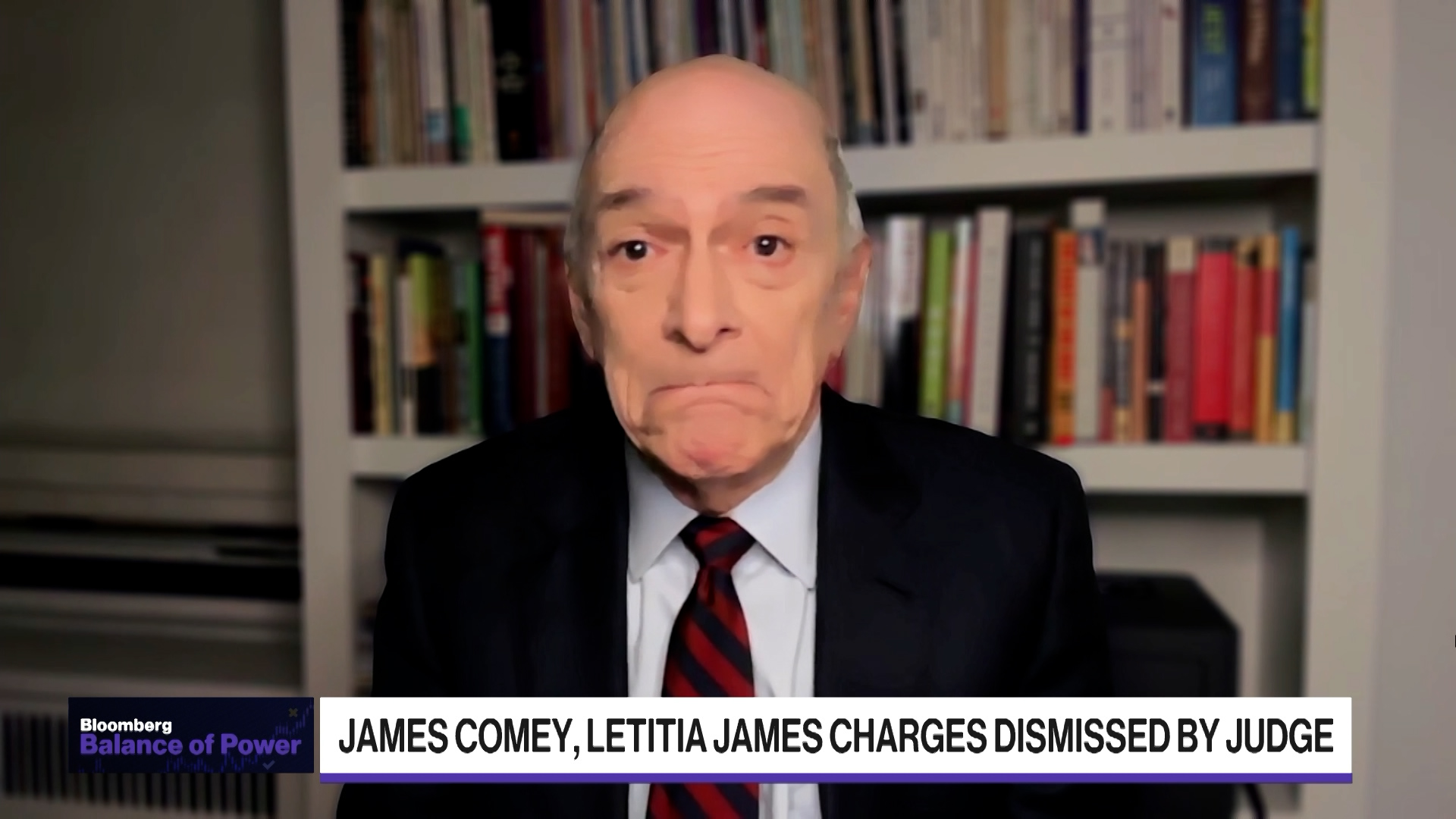
Bloomberg segments report a judge dismissed charges involving James Comey and Letitia James, while commentary warns the current Ukraine peace plan is unlikely to succeed and notes Ukraine is seeking security guarantees as negotiations continue. Separately, President Trump says he plans to visit China in April; the items are politically and geopolitically significant but contain no direct financial metrics or immediate market-moving details.
Market structure: Geopolitical friction that leaves Ukraine negotiations unresolved favors defense primes (LMT, NOC, RTX) and specialized ISR firms, and keeps oil and refined products bid; expect a 5–15% relative outperformance for large-cap defense vs. S&P over 3–6 months if talks stall. Conversely, European cyclical consumer travel and EM sovereign credit are most exposed to persistent risk premia, implying 3–8% underperformance potential in near-term earnings multiples. FX and rates will see two-way flows — a risk-off knee may push 10Y UST yields down ~10–25bp over days, while a positive China visit narrative could reflate risk assets and steepen curves within weeks.
Risk assessment: Tail scenarios include NATO involvement or a major battlefield escalation (oil +20–40%, equities down >10%), or a definitive diplomatic thaw (defense -10–20%, EM rally). Immediate (days) risk is volatility spikes of 2–4% in equities; short-term (weeks–months) risk is extended defense capex volatility and commodity swings of ±15%; long-term (quarters+) is fiscal reallocation toward defense adding 10–30bp to structural deficits. Hidden dependencies: US election messaging and tariff signalling around a China visit can flip sentiment rapidly; monitor tariff statements, PLA activity, and NATO communiqués as catalysts.
Trade implications: Establish 2–3% long positions in LMT and NOC (each) with 3–6 month horizons; hedge with 1–1.5% long TLT or futures to protect tail risk. Buy a 3-month Brent call spread sized to 2% notional that pays off if Brent rallies >15%; pair long defense (LMT) with short airlines (AAL) 1–2% to isolate defense vs. travel exposure. For volatility play, buy 3-month straddles on FXI or a China ETF sized 1% ahead of the confirmed China visit date, and reduce consumer discretionary exposure by 3–5% funded from cash or shorts.
Contrarian angles: The market underprices a prolonged security-guarantee negotiation: if Western parliamentary approvals slow, defense budgets could remain elevated for 12–24 months — a structural +5–12% EPS tailwind for primes. The opposite risk (a rapid diplomatic breakthrough) is also underpriced: yields and cyclicals could rebound quickly — set stop-loss thresholds (defense -12% or 10Y yield +30–50bp) to unwind. Historical parallels (2014–2016 regional standoffs) show defense outperformance persists beyond headline cycles; anticipate durability, not just a headline trade.
AI-powered research, real-time alerts, and portfolio analytics for institutional investors.
Request DemoOverall Sentiment
neutral
Sentiment Score
0.00
