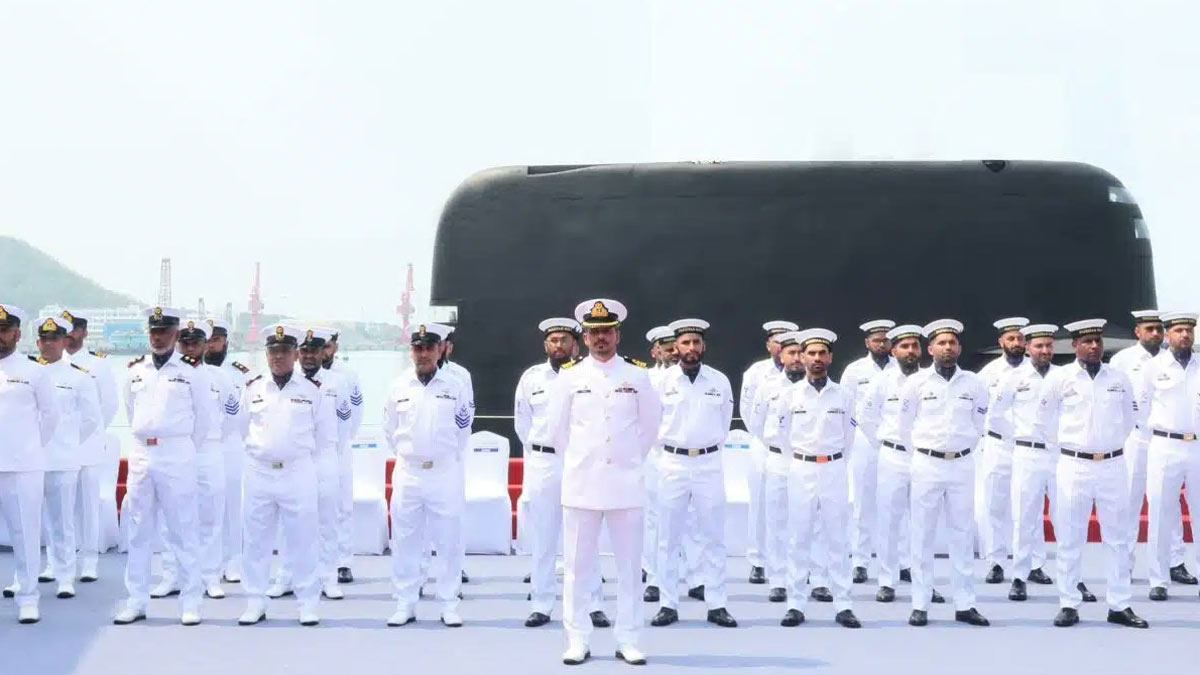
Pakistan has commissioned the PNS Hangor in China as the first of eight advanced Hangor-class submarines in a $5 billion program, with seven more expected by 2028 and all fitted with AIP systems and Babur 3 cruise missiles. The article argues this narrows India’s naval advantage, especially as India’s own six-submarine Project 75I deal with TKMS is not expected to deliver the first boat until 2032. The piece frames the development as a growing China-Pakistan military alignment with direct implications for South Asian defense balance.
The market implication is not the headline submarine count; it is the compression of India’s maritime decision window. A larger, quieter Pakistan conventional fleet with longer-endurance AIP boats and a land-attack cruise missile creates a cheaper deterrent than surface naval expansion, forcing India to spend disproportionate capital on anti-submarine warfare, ISR, and base hardening. That is a classic cost-imposition strategy: China is effectively subsidizing a capability that makes India defend a much broader ocean geometry at far higher unit cost.
Second-order, this is constructive for the defense procurement chain on both sides of the supplier/customer divide. Chinese shipbuilding, combat systems, propulsion, and missile integration gain export validation, while Indian naval modernization gets pulled forward politically but not necessarily executed faster, which widens the capability gap in the 2028-2035 window. The more important risk is not a near-term clash; it is that persistent undersea parity pressure raises the probability of an arms-race budget reallocation away from other Indian capital priorities.
The contrarian read is that the article overstates how quickly numbers translate into usable force. Submarine crew quality, maintenance uptime, sonar training, weapons integration, and Indian sea-denial assets can blunt much of the nominal gap for years. Still, the trend is unfavorable on a 12-36 month horizon because the first marginal advantage in undersea warfare usually comes from endurance and surprise, not fleet size, and those are exactly the attributes Pakistan is improving fastest.
AI-powered research, real-time alerts, and portfolio analytics for institutional investors.
Request DemoOverall Sentiment
moderately negative
Sentiment Score
-0.45
