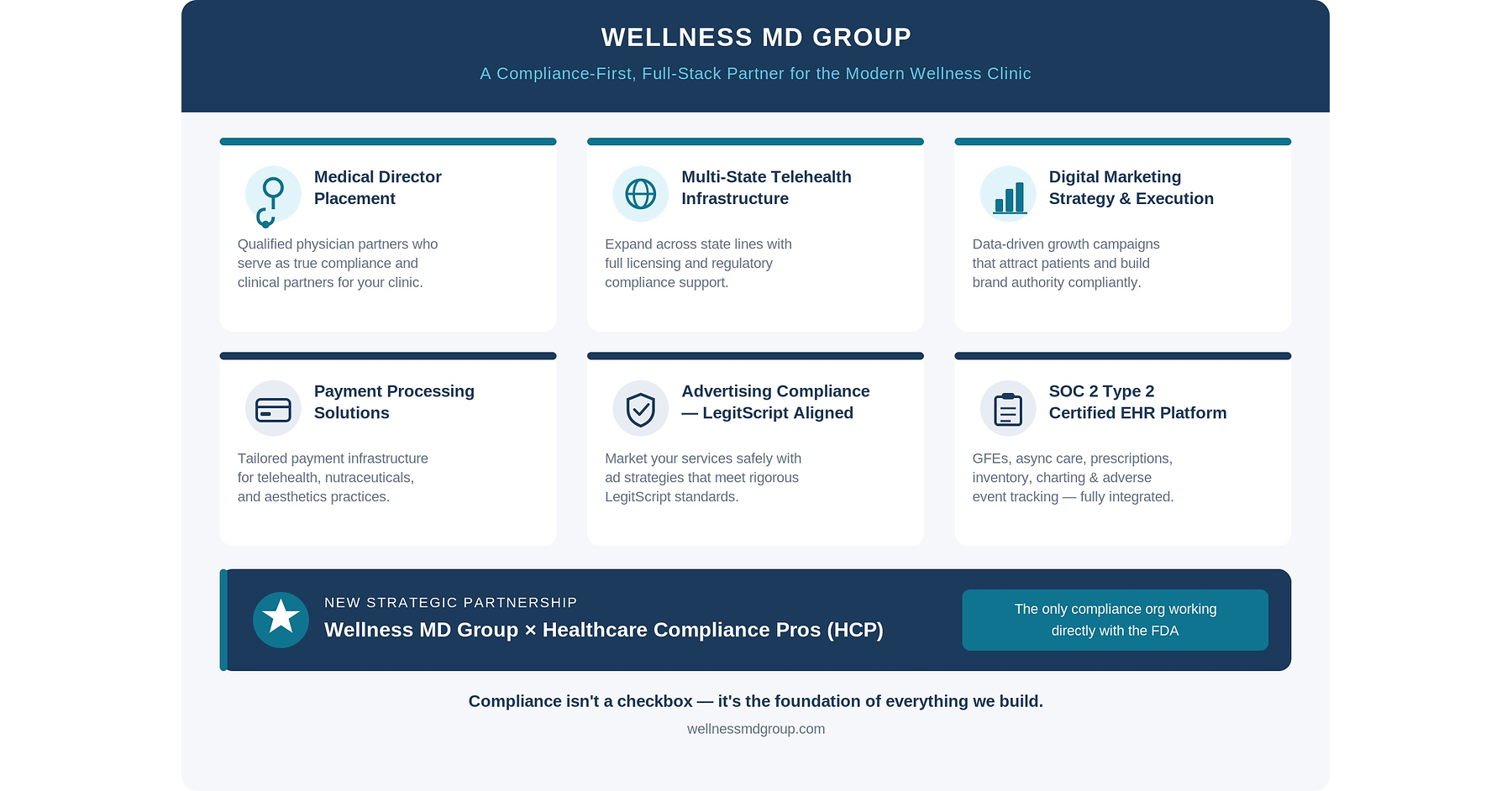
Wellness MD Group announced a strategic partnership with Healthcare Compliance Pros (HCP) to add FDA-level regulatory expertise to its compliance-first MSO platform for wellness clinics operating across multiple states. The platform bundles medical director placement, multi-state telehealth compliance, marketing within LegitScript-aligned policies, payment processing, and a SOC 2 Type 2-certified EHR, plus a preferred pharmacy network targeting prescription cost reductions of up to 60%. The news is primarily operational/product expansion with limited immediate implications for public markets.
This is less an earnings event than a signal that the economics of small wellness clinics are becoming more fixed-cost and compliance-heavy. That typically increases the value of scaled operators and vertically integrated platforms, while squeezing fragmented independents that rely on loose vendor stacks, paid search, and ad hoc pharmacy relationships. The market implication is a gradual widening of the gap between companies that can absorb regulatory overhead and those whose growth model depends on aggressive customer acquisition with thin governance.
The second-order effect is on channel economics: as compliance becomes a gatekeeper, paid digital channels get less efficient for low-quality operators, which should lower conversion rates and raise customer acquisition costs across the weaker end of the wellness/telehealth ecosystem. The likely winners are platform businesses with owned workflows, pharmacy rails, and defensible compliance processes; the losers are boutique clinics, outsourced marketing shops, and any telehealth model that treats legal review as a post-sale task. If regulators tighten on compounding, multi-state telehealth, or medical-director arrangements, that would accelerate consolidation over the next 1-3 quarters.
Near term, I would treat this as a watch item rather than a high-conviction public-equity trade: the press release is directionally supportive but not yet a measurable financial catalyst. Over 6-18 months, the thesis only works if compliance becomes a true barrier to entry rather than a marketing claim. Falsifier: if independent clinic formation and patient acquisition remain strong without a rise in enforcement actions, then the compliance premium is overstated and the moat is mostly narrative.
AI-powered research, real-time alerts, and portfolio analytics for institutional investors.
Request DemoOverall Sentiment
mildly positive
Sentiment Score
0.15
