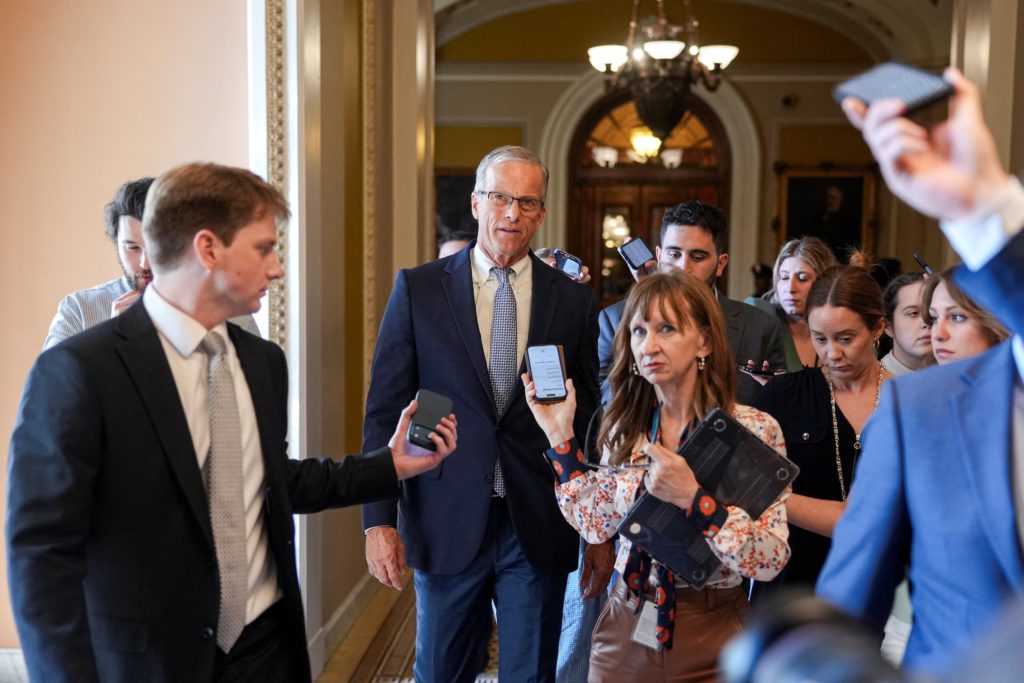
The House passed and President Trump signed a Homeland Security funding bill, ending the longest shutdown of a U.S. government agency in history and restoring funding for most DHS operations. The bill excludes ICE and Border Patrol for now, while a separate 45-day FISA extension was also approved to avoid an immediate lapse in surveillance authority. Separately, Trump withdrew surgeon general nominee Casey Means and is nominating Dr. Nicole Saphier instead.
The immediate market read is that the shutdown resolution is a relief rally for government-adjacent contractors and a mild negative for ICE-specific exposures, but the bigger signal is legislative bandwidth being consumed by stopgaps rather than durable appropriations. That tends to compress visibility for defense/infrastructure primes and any supplier with federal working-capital exposure, because cash conversion can lag even after headlines turn positive. In practice, the next 2-6 weeks matter more than the headline: payroll normalization helps, but procurement timing and invoice clearance are the real earnings bridge.
ICE’s underperformance risk is less about this one funding event and more about the sequencing problem: if Congress keeps using partial funding as leverage, ICE faces recurring narrative discounting around headcount, detention capacity, and technology spend. That can spill over into border-security vendors and certain data/biometrics names if investors start treating DHS budgets as politically callable rather than stable. The second-order winner is firms with broader non-federal revenue mixes, since they avoid being hostage to appropriations volatility.
The FISA extension removes a near-term legislative cliff, but it also delays clarity on surveillance authorities and the compliance regime around lawful intercept technologies. That is mildly positive for incumbents with existing federal relationships and negative for speculative reform trade ideas that were betting on a sharper reset. The surgeon-general reversal is a reminder that health-policy narratives can move quickly, but unless it changes vaccine or reimbursement policy, the market impact should remain mostly sentiment-driven and short-lived.
Contrarian view: the consensus may be overpricing the durability of today’s relief and underpricing the risk that repeated mini-crises force agencies to defer spending into later quarters. That means the trade is not simply 'buy the shutdown beneficiaries'; it is to favor balance-sheet strength and recurring commercial revenue over pure federal revenue exposure until appropriations normalize.
AI-powered research, real-time alerts, and portfolio analytics for institutional investors.
Request DemoOverall Sentiment
neutral
Sentiment Score
0.05
Ticker Sentiment
