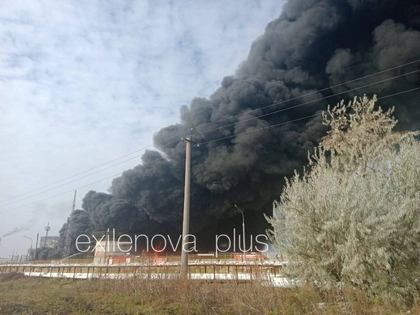
Russia is reinforcing air defenses around key oil export infrastructure in its northwest after repeated Ukrainian drone strikes on Baltic Sea ports Ust-Luga and Primorsk. The attacks have disrupted operations, exposed vulnerabilities in Russia's energy logistics, and reportedly cost nearly $1 billion in a week in March. Continued strikes on oil terminals and pumping stations could further pressure Russian export volumes and energy revenue.
The market is still underpricing how asymmetric the logistics choke-point risk is: these attacks do not need to destroy large volumes of crude to matter, they only need to intermittently degrade scheduling confidence at a handful of export nodes. That raises the effective risk premium on Russian barrels and widens the discount needed to clear cargoes, which can ripple into global refined-product pricing even if headline Brent does not move much. The second-order winner is non-Russian export optionality—Middle East, USGC, and North Sea barrels become more valuable as buyers pay for reliability rather than just price.
For shipping and insurance, the more important variable is not outright lost supply but volatility in loading windows, which can force demurrage, rerouting, and higher war-risk premia. That tends to benefit operators with cleaner routes and stronger fleet positioning while hurting any tanker exposure with heavy Baltic or Black Sea adjacency. On the refining side, intermittent Russian export disruption can actually support cracks outside Russia if product flows tighten, but if Moscow responds by redirecting crude into less efficient domestic storage or cutbacks, the lag effect could show up over weeks rather than days.
The contrarian view is that the current move may already be partially priced as a persistent escalation premium, while the real setup is a regime change in defense allocation: Russia will likely harden a few critical nodes and leave marginal infrastructure vulnerable. That means the “tail risk” is not a one-off supply shock but a rolling campaign that keeps traders from anchoring on a stable Russian export assumption. The tradeable implication is to own volatility and reliability winners rather than directional oil beta alone.
If strikes continue at near-daily frequency for another 2-6 weeks, expect a larger re-pricing in freight, insurance, and refined-product spreads than in outright crude. If Ukraine signals a pause or Russia demonstrably restores load reliability, the premium can unwind quickly because the market is currently reacting to operational fragility, not reserve depletion.
AI-powered research, real-time alerts, and portfolio analytics for institutional investors.
Request TrialOverall Sentiment
strongly negative
Sentiment Score
-0.55
