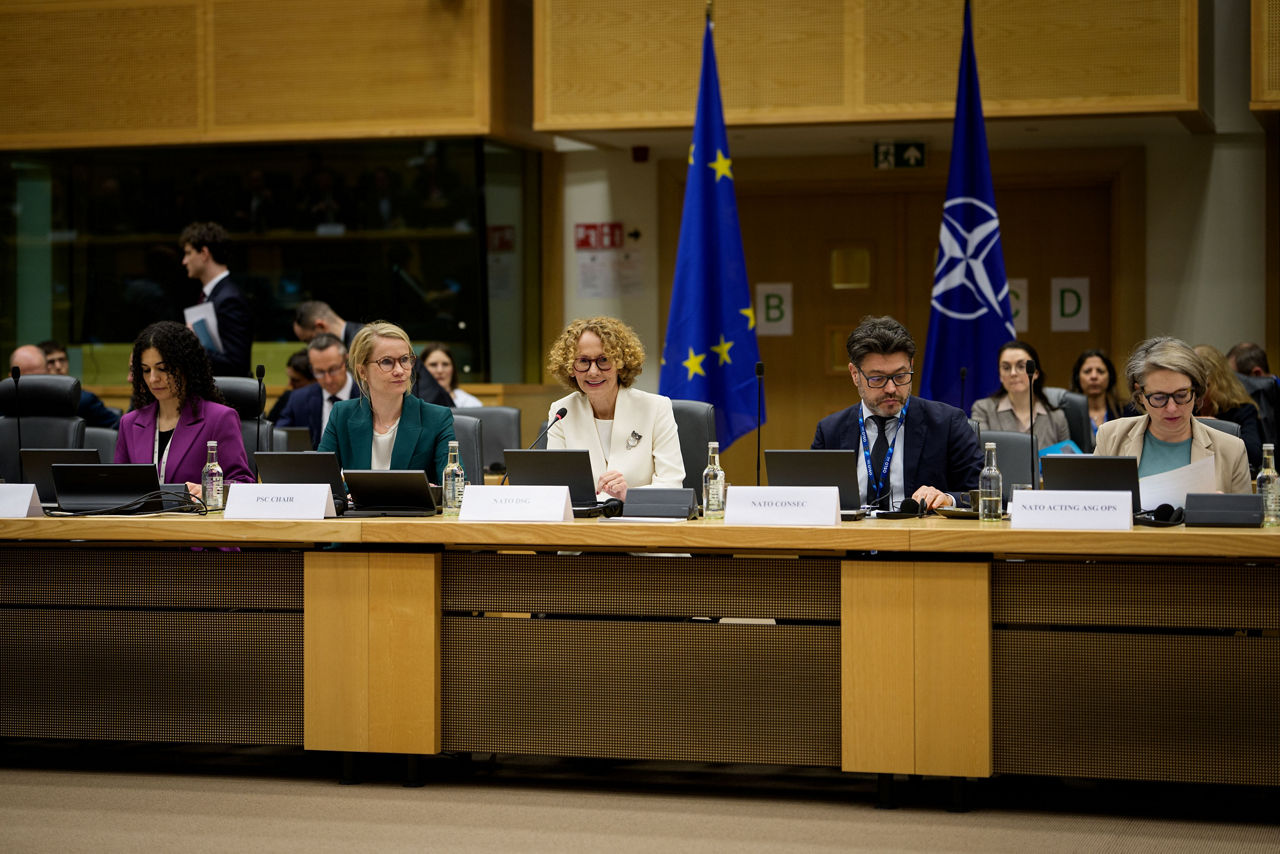
NATO and the EU held an informal joint meeting in Brussels on 23 April 2026 focused on Ukraine, with Deputy Secretary General Radmila Shekerinska calling for predictable, coordinated, and sustained long-term support. NATO highlighted multiple support mechanisms for Ukraine, while the EU noted its military training mission has trained 90,000 Ukrainian soldiers. The update is policy-oriented and incremental, with limited direct market impact.
The near-term market read-through is not “more aid,” but a longer-duration procurement runway for European defense, logistics, and communications vendors. The coordinated NATO-EU process lowers policy friction and makes multi-year funding commitments more bankable, which tends to favor primes and subsystem suppliers with backlog exposure rather than headline-sensitive platform names. The second-order effect is a gradual re-rating of European defense capacity expansion: investors should expect capex on munitions, air defense, secure comms, training, and maintenance to stay elevated even if frontline headlines fade.
The more important implication is that support is becoming institutionalized rather than event-driven. That reduces the probability of abrupt funding gaps, but it also raises the odds of repeat procurement waves every 3-6 months as inventories are replenished and training capacity is scaled. The beneficiaries are likely to be suppliers with short lead times and fungible production lines; losers are firms reliant on one-off national orders or those without NATO-standard certifications, because the coordination mechanism increasingly rewards interoperability and rapid delivery.
The main risk is political drift, not battlefield headlines: if fiscal pressure in Europe intensifies or US policy becomes less predictable, the market could de-rate the “durable support” assumption quickly. A contrary outcome would be a settlement or ceasefire that reduces urgent demand for ammunition and training, but even then Europe’s structural restocking cycle likely persists for years. The consensus may still be underestimating how much of this flows into dual-use infrastructure, cyber, and command-and-control rather than only into tanks and aircraft.
For relative value, the setup favors a basket approach over single-name beta because the trade is about sustained budget allocation and supply-chain bottlenecks, not a one-day headline spike. Timing matters: the next scheduled joint meetings in September and December create identifiable catalysts for renewed procurement language, funding updates, or capability announcements. In the interim, volatility likely compresses in broad defense ETFs while earnings revisions for suppliers with European exposure continue to drift higher.
AI-powered research, real-time alerts, and portfolio analytics for institutional investors.
Request TrialOverall Sentiment
neutral
Sentiment Score
0.05
