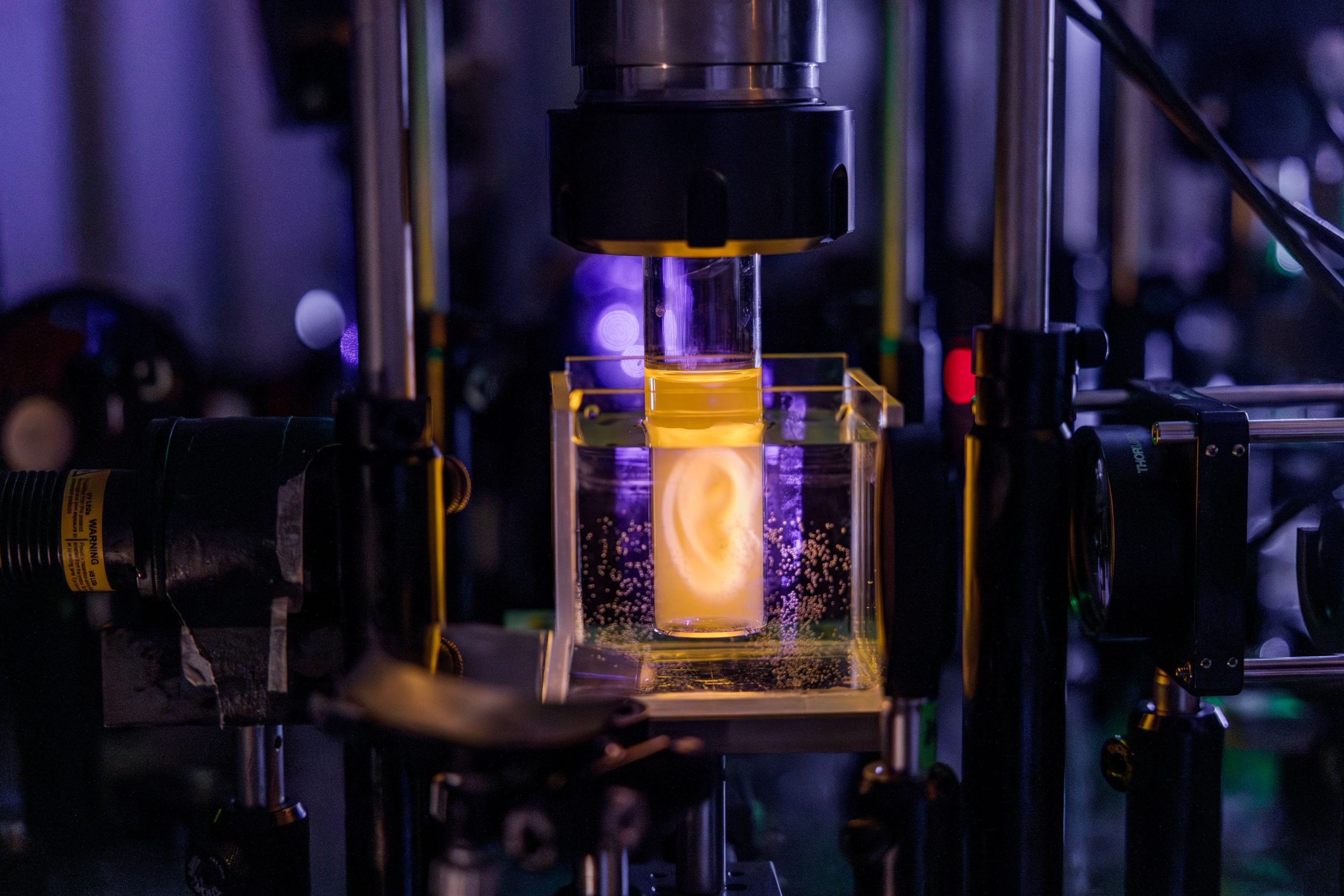
EPFL researchers unveiled a holographic volumetric 3D-printing platform that is 70 times more efficient than prior systems, producing millimeter-scale objects in seconds and centimeter-scale objects in minutes. The system successfully printed a life-sized human ear using a 150 mW laser diode, while embedded cells in a 64 mm3 construct remained viable after six days and formed organized networks. The advance materially improves speed, precision, and scalability for bioprinting and near-clinical tissue fabrication, though near-term market impact is likely limited.
This is less a single-scientific-breakthrough story than a platform inflection: once volumetric printing stops wasting photons, the bottleneck shifts from optical throughput to materials science, process control, and regulatory validation. That changes the competitive map for bioprinting because the moat moves away from lab demos and toward whoever can solve reproducibility in cell-laden resins, sterile manufacturing, and post-print maturation. The immediate beneficiaries are likely enabling-tool vendors and materials suppliers rather than the eventual implant OEMs.
The second-order effect is that this compresses the timeline for ex vivo tissue models and custom surgical scaffolds before it meaningfully impacts transplant medicine. Near term, the commercial wedge is likely preclinical drug testing, cosmetic/reconstructive planning, and high-value hospital workflows where customization justifies premium pricing. If this scales, it also pressures incumbent tissue-engineering approaches that depend on slower fabrication or weaker geometric fidelity, and it could pull share from certain organoid and scaffold-adjacent platforms.
The market is probably underestimating how long the regulatory layer will delay monetization. A working ear-sized construct does not translate into broad clinical adoption; the gating items are long-term cell viability, vascularization, sterilization, and liability standards, so meaningful revenue is more likely 2-5 years out than 2-5 quarters. The contrarian risk is that investors extrapolate too quickly and bid up bioprinting names on scientific headlines even though the value capture may accrue to lasers, optics, automation, and specialty resins rather than the headline biotech companies.
The best trade setup is to own the picks-and-shovels and fade the pure-play hype basket. If this thesis compounds, it should also create a M&A path: larger medtech or industrial-photonic firms may buy niche IP rather than build internally, especially if low-power, high-precision printing becomes a hospital-deployable module. Watch for follow-on data on higher cell density and direct printing onto existing tissue; that is the catalyst that would convert this from a research win into a commercial platform story.
AI-powered research, real-time alerts, and portfolio analytics for institutional investors.
Request DemoOverall Sentiment
strongly positive
Sentiment Score
0.78
