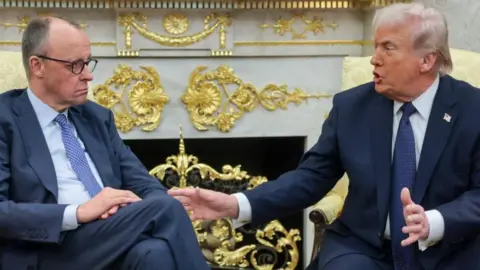
The US plans to withdraw 5,000 troops from Germany, with completion expected over the next 6 to 12 months, prompting NATO to seek clarification and raising concern over alliance cohesion. Germany currently hosts more than 36,000 active-duty US troops, by far the largest US deployment in Europe, and officials in Berlin and Brussels say the move underscores the need for Europe to take on more defense responsibility. The decision follows a public spat between Trump and Merz and could weigh on European defense positioning and NATO-related sentiment.
This is less about the near-term optics of a troop rotation and more about a steady repricing of Europe’s security backstop. The market should treat it as another data point that raises the probability of structurally higher European defense budgets, which is bullish for multi-year order backlogs across munitions, air defense, ISR, and base infrastructure. The second-order effect is margin durability: primes with already-full books can push pricing harder when governments are forced into faster procurement cycles and greater domestic sourcing.
The biggest beneficiary is not necessarily the headline defense primes that rallied on the first wave of the Ukraine shock, but the middle layer of the industrial chain: ammunition, sensors, electronic warfare, and construction/logistics firms tied to rapid force posture changes. A smaller US footprint in Germany also creates more work for European host-nation support and infrastructure spending, which should spill into local contractors and utilities near major bases. Meanwhile, the risk is that Washington uses withdrawals as leverage rather than a clean exit, making the pain episodic in the near term and blunting the knee-jerk trade if diplomacy stabilizes headlines.
Consensus may be underestimating how much of this has already been partially discounted in European defense equities, while underpricing the beneficiaries of intra-European burden shifting. If Germany’s fiscal outlays keep rising toward the implied 3%+ zone, the real alpha is likely in names with exposure to replenishment, maintenance, and munitions rather than platform-heavy primes that depend on long-cycle programs. The main reversal catalyst would be a coordinated NATO clarification that pauses further withdrawals and signals no change to force posture; that would cap the trade over days, but not erase the multi-quarter budget impulse.
AI-powered research, real-time alerts, and portfolio analytics for institutional investors.
Request DemoOverall Sentiment
mildly negative
Sentiment Score
-0.35
