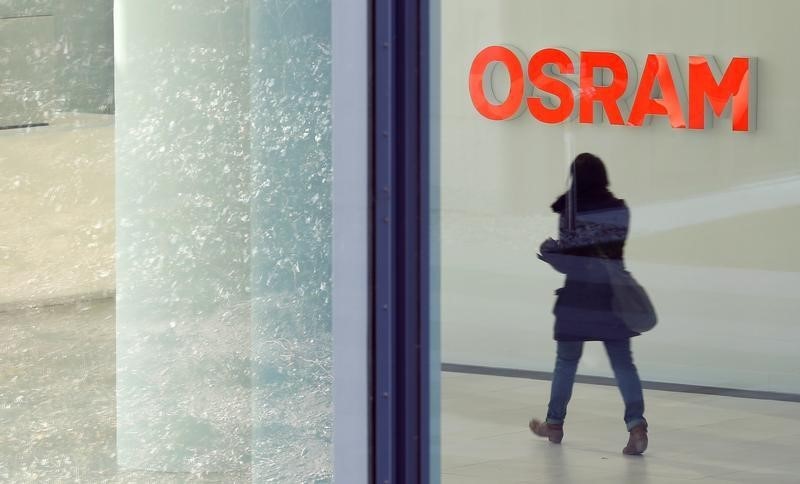
Jefferies upgraded ams OSRAM to Buy from Hold and more than doubled its price target to CHF 21 from CHF 8.30, citing cyclical recovery and new revenue opportunities in AI data-center connectivity and AR smart glasses. The broker sees potential for triple-digit million-euro annual sales from AI photonics and roughly €375 million of revenue in 2028 from Meta-related AR components at around 5 million glasses. Shares rose more than 6% on the upgrade and improved medium-term outlook.
The market is underappreciating how asymmetric this setup is for META relative to the direct beneficiary here. If even a small portion of AR smart-glasses bill-of-materials migrates to higher-performance microLED stacks, suppliers with real production scale and optical-electronics IP can see option value re-rate long before end-demand is proven. That creates a second-order winner dynamic: META gains bargaining leverage on component pricing and supply security, while legacy laser-based interconnect vendors face a longer commercialization overhang than the market currently prices.
For MSFT, the relevance is less about near-term revenue and more about validation of the AI data-center interconnect roadmap. If alternative emitter architectures continue to improve on power and bandwidth, hyperscale capex could tilt toward architectures that optimize energy per bit rather than raw throughput, which is a subtle but important margin lever for cloud operators over a 3-5 year horizon. The near-term read-through is that optical-component suppliers with credible lab-to-fab transition paths should trade at a premium, even if revenue visibility remains distant.
The contrarian issue is timing: this is a narrative upgrade, not a cash-flow upgrade, and the market usually over-discounts long-dated TAM stories after the first re-rate. The stock can keep moving if auto/industrial restocking is real, but the AI photonics call is likely to be the higher-beta driver because investors will pay for scarcity value in a strategic component supplier. The main reversal risk is execution slippage in microLED yield or a slower-than-expected AR device ramp, either of which would pull the valuation back toward the cyclical base case within 1-2 quarters.
In the broader tech complex, this is mildly negative for any company whose AI thesis depends on incumbent interconnect assumptions staying intact, but the signal is strongest for names exposed to component bottlenecks and platform owners with ecosystem control. META looks like the cleaner indirect beneficiary because it can leverage supplier competition to lower future device cost while preserving upside optionality in wearables. The move is likely underdone if the market is still treating AR as a hobbyist side project rather than a real roadmap with multi-million-unit potential.
AI-powered research, real-time alerts, and portfolio analytics for institutional investors.
Request DemoOverall Sentiment
moderately positive
Sentiment Score
0.62
Ticker Sentiment
