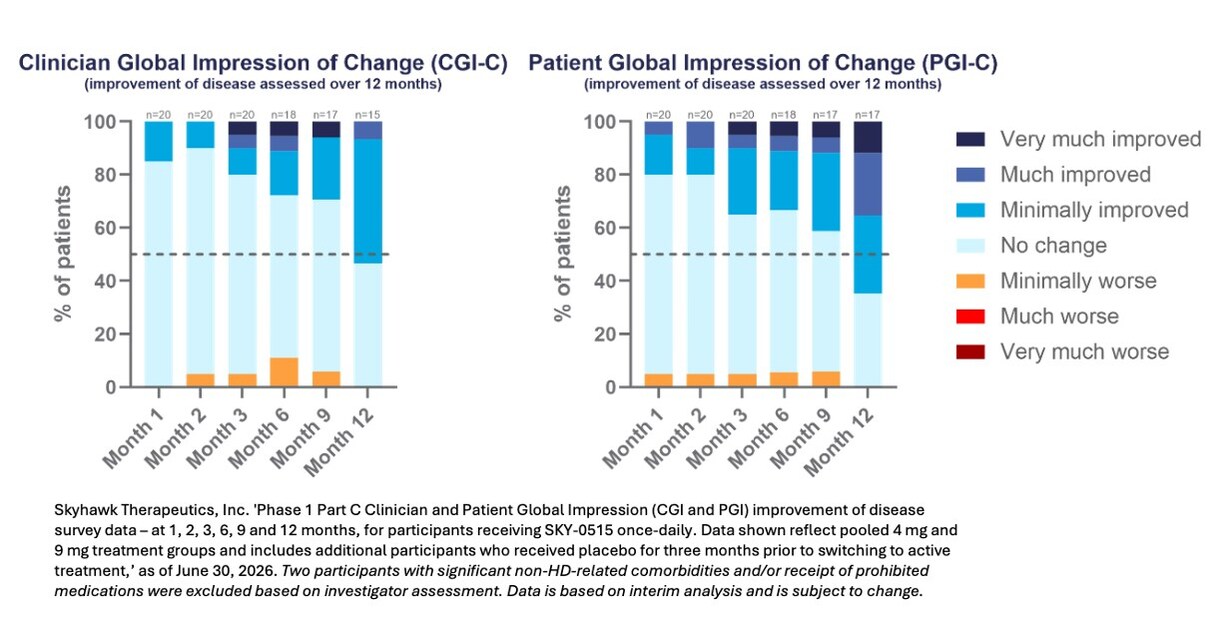
Skyhawk Therapeutics reported 12-month cUHDRS subcomponent results for SKY-0515, showing favorable changes vs. expected natural-history worsening: TFC +0.07 vs -0.87, TMS -2.00 vs +2.21, SDMT -0.19 vs -1.78, and SWRT +3.44 vs -3.13. In addition, clinician and patient CGI/PGI assessments reported no observed worsening among patients expected to decline, with 65% of participants and 50% of physicians indicating improvement. SKY-0515 also produced dose-dependent reductions in blood mHTT up to 69% and PMS1 mRNA up to 26%, alongside generally safe and well-tolerated CNS exposure.
The market implication is less about Skyhawk’s private valuation and more about how much harder this makes the bar for other Huntington’s names. If an oral CNS-penetrant small molecule can keep showing biomarker knockdown and apparent functional stability, the next 6-12 months shift investor focus from “can you lower HTT?” to “can you prove durable functional benefit with acceptable chronic safety?” That is a tougher standard for chronic-dosing platforms like WVE and a selective risk for programs still leaning on biomarker narratives.
The biggest second-order effect is capital allocation. A credible oral modality with multi-target biology raises the premium on convenience and manufacturability versus invasive CNS delivery or one-time irreversible approaches, but only if the controlled data hold up. The CGI/PGI color is not decision-grade; those endpoints are highly expectation-sensitive in open-label extensions, so the real catalyst is the randomized FALCON-HD readout and whether cUHDRS separation persists against placebo over 6-12 months.
Contrarian view: this may be an over-read on an early-stage asset. mHTT reduction is necessary, not sufficient; PMS1 suppression is mechanistically interesting but also adds off-target and chronic-tolerability questions. If the placebo-controlled phase 2/3 data fail to confirm functional divergence, the sympathy bid in HD-related biotech should fade quickly; if they do confirm, the re-rating is broader than one company and could reprice the entire HD platform basket.
AI-powered research, real-time alerts, and portfolio analytics for institutional investors.
Overall Sentiment
strongly positive
Sentiment Score
0.55
