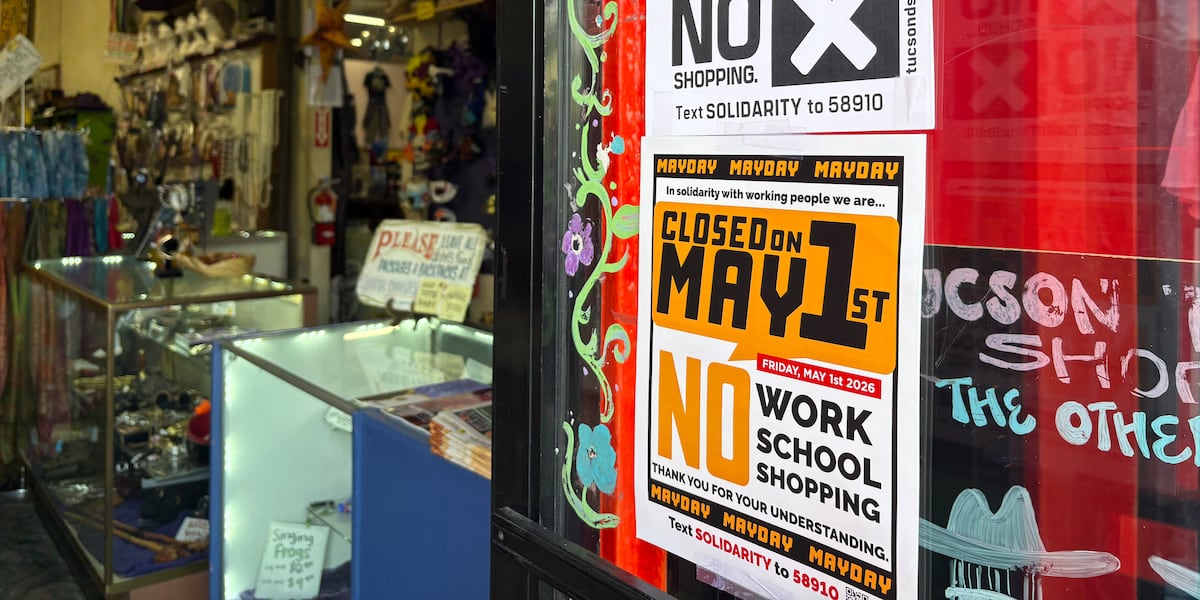
Tucson businesses are preparing for May Day closures as part of a national no work, no school, no shopping protest, with dozens of local stores expected to shut on Friday. The article flags a possible short-term hit to small-business sales in southern Arizona, especially as higher gas and input costs already pressure margins. Local advocates say the sacrifice supports workers’ rights, while business leaders urge shoppers to redirect spending to small, local retailers.
The immediate market impact is less about one lost Friday of sales and more about whether this becomes a repeatable “soft boycott” template. Small, locally dependent retailers are the most exposed because they lack pricing power and fixed-cost flexibility, so even a modest one-day traffic hit can leak into cash conversion through inventory overhang, labor scheduling inefficiency, and lower same-store-sales momentum into the following week.
The second-order effect is competitive: national chains and pure-play e-commerce can absorb a localized blackout, but neighborhood merchants may actually lose share if consumers substitute purchases to larger formats before or after the event. That means the net economic pain is likely concentrated in the weakest balance-sheet retailers, not the broad consumer sector, which is why the headline feels bigger than the index-level damage it should produce.
The risk case is duration. If the action is socially amplified and repeated monthly or around high-visibility dates, it can start to matter for traffic-sensitive names and local-adjacent shopping centers, especially in secondary markets. The reversal catalyst is simple: if organizers fail to sustain participation, the effect fades back to noise after one cycle; if participation broadens, the issue shifts from symbolic protest to a measurable demand headwind.
Consensus is probably overestimating the macro signal and underestimating the distributional effect. This is not a consumer-spending collapse; it is a margin stress event for small businesses with little buffer, which can create a short-lived but tradable divergence between local retail exposure and national retail proxies.
AI-powered research, real-time alerts, and portfolio analytics for institutional investors.
Request DemoOverall Sentiment
mildly negative
Sentiment Score
-0.20
