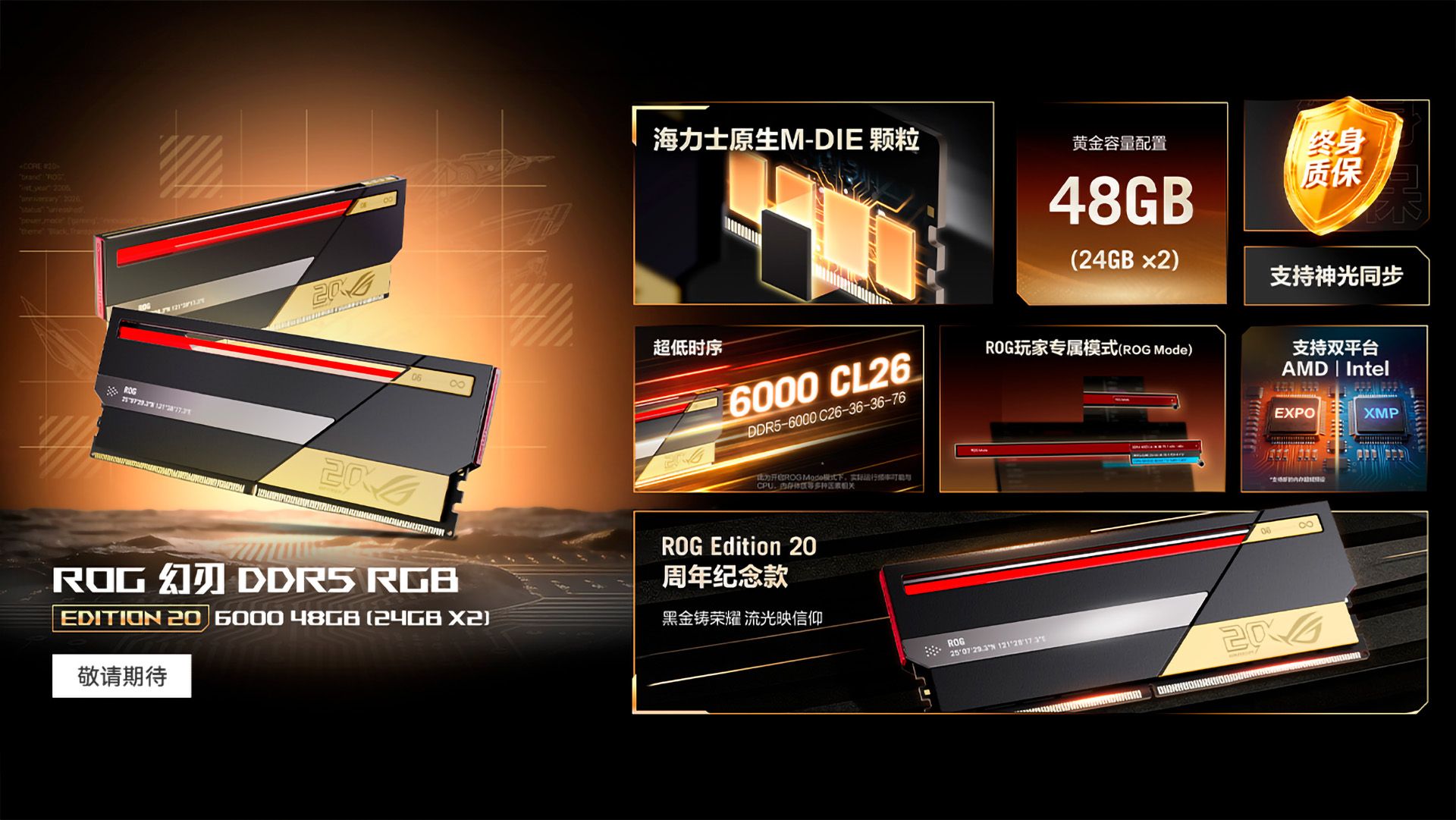
Asus unveiled its first retail memory kit, the ROG 48GB DDR5-6000 C26 RGB 20th Anniversary Edition, priced at $880 and launching in late June. The kit includes two 24GB modules, supports AMD EXPO and Intel XMP, and can be boosted via a ROG-only BIOS profile to DDR5-8000 with 1.40V. While the launch expands Asus’s ROG ecosystem and highlights tight memory supply conditions, the article is primarily a product announcement with limited direct market impact.
This is less a “new product” story than a pricing signal that the memory market has moved from shortage to rationing. When a premium consumer brand can clear a vanilla enthusiast kit at an extreme markup, it implies the marginal buyer is already paying for allocation certainty rather than performance, which tends to extend high gross margins for upstream component suppliers before it hits downstream assemblers. The near-term beneficiaries are not the brand owner so much as the DRAM ecosystem: makers with constrained capacity and the best bin access can keep ASPs elevated even if retail demand softens.
The second-order risk is that a branded launch like this becomes a visible top-of-funnel indicator that OEMs will keep chasing memory inventory for several quarters. That supports near-term earnings revisions for memory-vendor exposure, but it also raises the probability of demand destruction in consumer PCs by mid-2026 if system BOM inflation keeps compounding. If laptop and desktop buyers delay upgrades, the pain migrates from components to assemblers and retailers, especially those with weaker pricing power and higher inventory turns.
For AMD, this is mildly supportive at the margin because higher memory prices disproportionately tax AI- and gaming-oriented configurations, which could push some buyers toward bundled, prebuilt, or integrated solutions rather than DIY refreshes. But the biggest interpretation is cyclical, not competitive: memory scarcity can remain self-reinforcing for 1-2 quarters, yet the setup also plants the seeds for a sharp mean reversion once supply catches up or channel inventory clears. The consensus may be underestimating how quickly “premium” pricing turns into demand elasticity if MSRP inflation spills from components into full systems.
Contrarianly, the market may be overfocusing on the scarcity headline and underweighting the duration risk. A luxury-priced flagship kit does not prove broad-based end-demand strength; it may simply reveal that vendors are trying to preserve margins at low unit volumes while retail buyers balk. The more important tell will be whether mainstream 32GB and 64GB kit pricing stays sticky over the next 60-90 days; if it does not, this becomes a short-lived halo event rather than a durable profit cycle.
AI-powered research, real-time alerts, and portfolio analytics for institutional investors.
Request DemoOverall Sentiment
neutral
Sentiment Score
0.12
Ticker Sentiment
