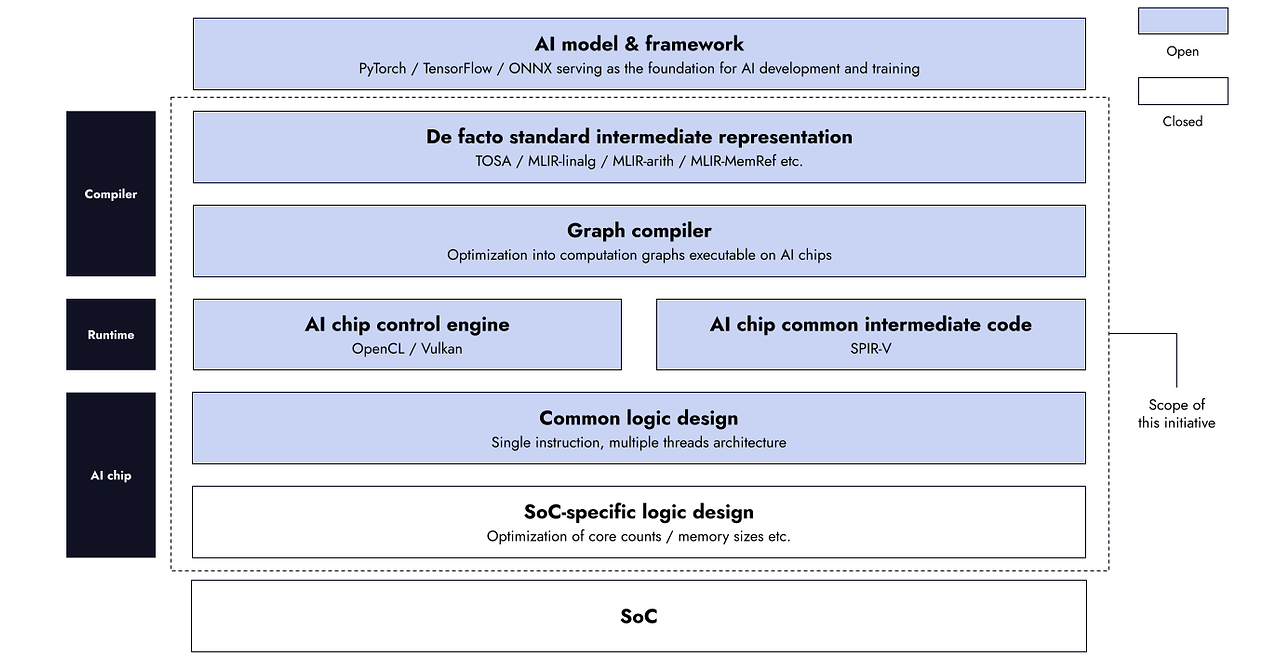
TIER IV joined JST’s Next-Generation Edge AI Semiconductor R&D program to develop a software-defined SoC logic design for Level 4 autonomous driving, with open-sourcing of chip design assets plus the compiler/toolchain. The work targets Transformer inference performance per watt for end-to-end autonomy and introduces TOSA (Tensor Operator Set Architecture) to decouple AI models/frameworks from hardware, alongside formal verification to ensure numerical consistency and error tolerances. While not a public-market earnings catalyst, the initiative is a constructive step toward scalable, open AI-chip ecosystems for Japan’s Level 4 deployment efforts.
This is strategically positive for the autonomy stack, but the monetization path is still long-dated. The real value is not the chip itself; it is the attempt to separate model iteration from hardware redesign, which could compress integration cycles for L4 programs and reduce dependency on a single proprietary compute vendor. That matters most for automakers and robotics players that cannot justify GPU-class power draw in the vehicle, but it is unlikely to move listed earnings in the next 1-3 months.
Second-order, an open compiler/toolchain lowers switching costs across the ecosystem, which is constructive for whoever sells automotive silicon manufacturing, IP, or verification services. That could be a medium-term tailwind for ARM, Renesas, NXP, TSMC, and selected EDA names, while making it harder for closed autonomy stacks to sustain premium software rents if open alternatives reach acceptable safety and performance. The likely near-term loser is not a specific public company, but the thesis that “general-purpose compute plus software” will dominate all edge autonomy use cases.
Contrarian view: consensus may overread this as a commercial chip breakthrough when it is really a standards-and-ecosystem play. The hard gates are automotive qualification, formal verification at scale, and whether any OEM will commit volume to an open design before a proprietary solution is already validated. If no tape-out, no OEM design win, and no foundry/partner announcement arrives within 6-12 months, the market should treat this as strategic signaling rather than an investable revenue catalyst.
AI-powered research, real-time alerts, and portfolio analytics for institutional investors.
Request DemoOverall Sentiment
mildly positive
Sentiment Score
0.25
Ticker Sentiment
