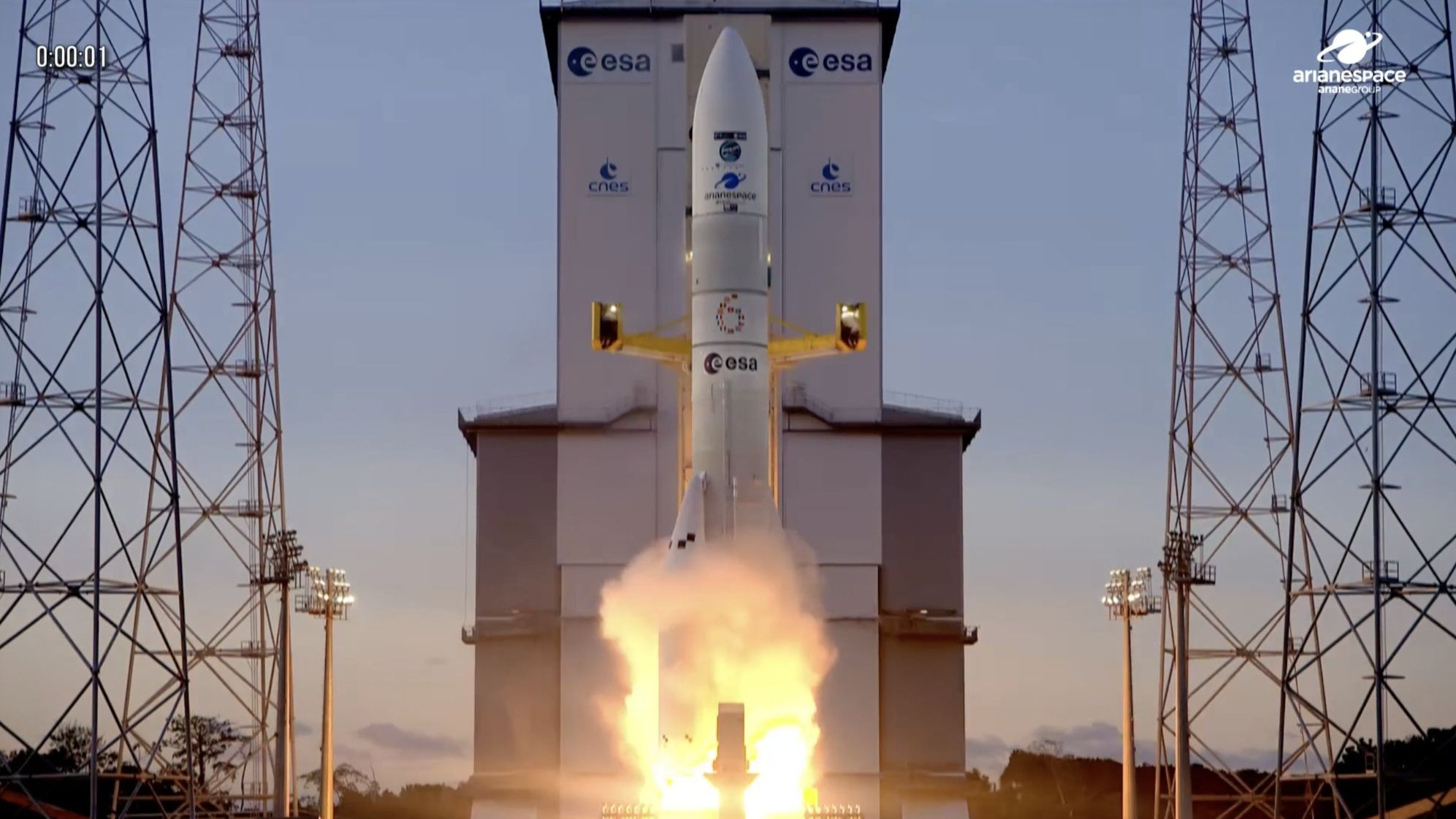
Europe's Ariane 6 rocket successfully completed its fourth launch, and third consecutive operational mission, deploying the Sentinel-1D Earth-observation satellite. This mission is vital for the EU's Copernicus program, bolstering radar imagery for disaster response and environmental monitoring. While marking a consistent operational streak for the Ariane 5 successor, Europe's total of five orbital missions this year, including Vega C flights, highlights a significant disparity in launch cadence compared to competitors like SpaceX, which has executed 140 missions in the same period.
Europe's Ariane 6 rocket successfully completed its fourth launch, deploying the Sentinel-1D Earth-observation satellite, marking its third consecutive operational success since a "checkered" test flight in July 2024. This mission ensures the continuity of critical radar imagery for the EU's Copernicus program, supporting disaster response, environmental monitoring, and maritime surveillance. The successful deployment underscores Europe's commitment to maintaining strategic autonomy in space infrastructure.
The Sentinel-1D satellite, replacing the aging Sentinel-1A, will work with Sentinel-1C to provide high-resolution C-band SAR and AIS data, vital for climate science and various public and private sector applications. This operational reliability by Arianespace is a positive signal for European space capabilities.
However, Europe's total of five orbital missions in 2025 (three Ariane 6, two Vega C) starkly contrasts with SpaceX's 140 Falcon 9 missions in the same period, with a majority for Starlink. This significant disparity in launch cadence highlights ongoing challenges for European launch providers in achieving commercial scale and competing for market share against high-volume operators.
AI-powered research, real-time alerts, and portfolio analytics for institutional investors.
Overall Sentiment
strongly positive
Sentiment Score
0.70
