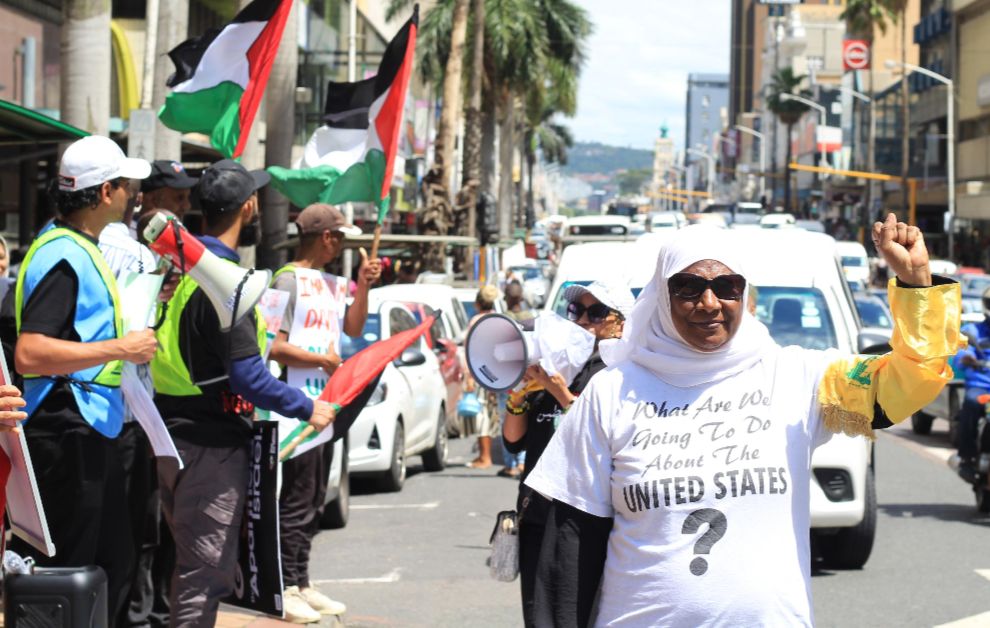
Activists staged a peaceful protest outside the US Consulate in Durban following the reported assassination of Iranian Supreme Leader Ali Khamenei and an airstrike that killed 165 schoolgirls and teachers, with participants from the South African Palestine Movement, KZN Palestine Solidarity Forum and the Congolese Solidarity Campaign. Protesters accused the US of enabling violence, raised broader allegations of genocide in Congo, and urged boycotts of American/Israeli consumer brands (citing McDonald's, KFC, Nestle), a stance that could modestly pressure consumer multinationals and heighten geopolitical risk for emerging-market exposures and investor sentiment.
Market structure: The Durban protest is a localized consumer boycott signal but, combined with the reported assassination and regional outrage, raises tail geopolitical risk that favors safe-havens (gold GLD, miners GDX), energy majors (XOM/CVX) and defense contractors (LMT/RTX). Direct damage to US consumer brands (MCD, YUM, NSRGY) is likely <1% revenue impact globally but can depress local sales and sentiment in South Africa, pressuring EZA and ZAR in the short term.
Risk assessment: Near-term (days) expect spikes in FX volatility (ZAR -3%+ intraday) and EM sovereign spreads widening 20–80bps; short-term (weeks/months) see oil moves ±5–15% on escalation risk; long-term (quarters) structural shifts (onshoring, supply-chain re-routing) could raise defense and diversification capex. Tail scenario: a shipping strait disruption or broad sanctions could lift Brent 20–40% and catalyse stagflation — plan for that low-probability, high-impact outcome.
Trade implications: Tactical trades: buy 3-month GLD (2–3% portfolio) and 1–2% GDX exposure as volatility hedge; add 1% long LMT/RTX for 6–12 months if media escalation continues. Hedge EM risk by shorting 1–2% EZA or buying 3-month puts on EZA if ZAR weakens >3% intraday; use USO call spreads (3-month) if Brent breaks +5% from current levels.
Contrarian angles: The consensus boycott narrative likely overstates durable sales impact — historical parallels (2011 Arab Spring) show global brands recover within quarters; mispricing exists in beaten-up EM ETFs (EEM/EZA) where repricing overshoots fundamentals. Unintended consequence: an aggressive defense long will underperform if rapid diplomatic de-escalation occurs; set quantitative stop/triggers (VIX <15, Brent down >5%) to unwind.
AI-powered research, real-time alerts, and portfolio analytics for institutional investors.
Request TrialOverall Sentiment
moderately negative
Sentiment Score
-0.40
