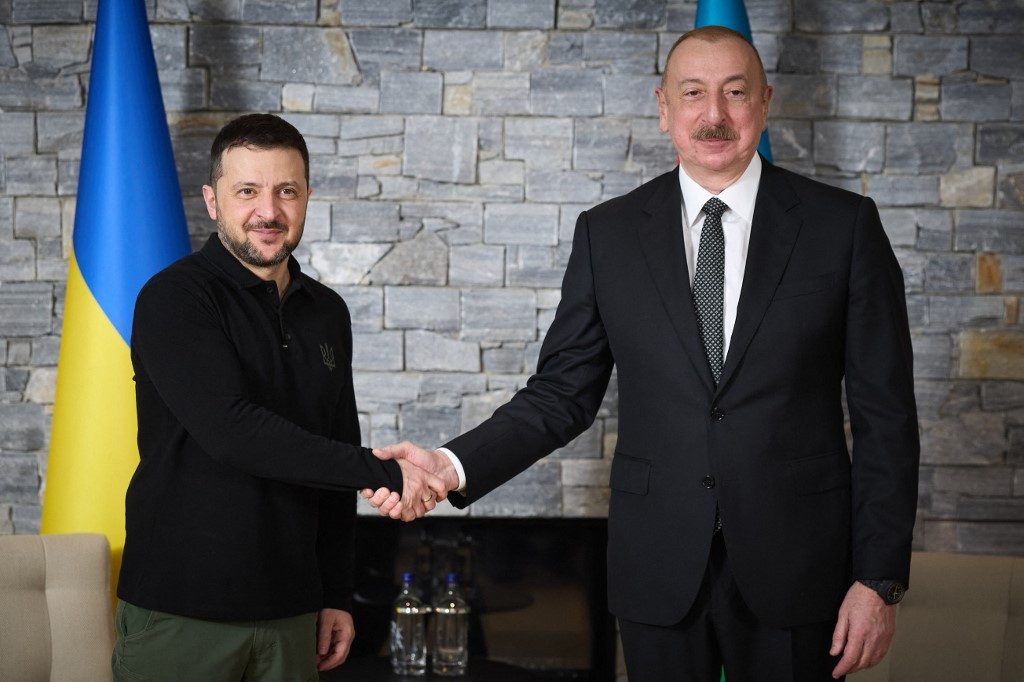
President Volodymyr Zelensky arrived in Azerbaijan for talks focused on security and energy cooperation, marking the first visit by a Ukrainian leader to a South Caucasus country since Russia’s 2022 invasion. The article also notes improving Azerbaijan-Ukraine ties after the December 2024 AZAL plane downing, and that five Azerbaijani tankers were removed from the EU’s 20th sanctions package. Overall, the piece is geopolitically relevant but does not describe an immediate market-moving economic or policy shock.
This is less about one-off diplomacy and more about a gradual rewiring of Eurasian logistics away from Russian chokepoints. Azerbaijan is becoming a useful hinge state: energy transit, drone/defense know-how exchange, and a political bridge to Gulf states all reduce Moscow’s ability to isolate regional actors. The second-order effect is that any improvement in Azerbaijan’s external alignment raises the strategic value of the Middle Corridor, which is constructive for non-Russian rail, port, and pipeline assets over the next 12–24 months.
The sanctions angle matters more than the headline suggests. The removal of Azerbaijani tankers from the EU package signals that enforcement remains negotiable when a supplier is strategically useful, which weakens the “hard stop” narrative around shadow-fleet financing. That likely compresses risk premia for legitimate Azeri shipping and energy counter-parties while increasing the value of firms with flexible ownership structures and non-Russian routing optionality. The flip side is that it reduces the probability of a broad escalation in EU-Azerbaijan friction in the near term, which is mildly bearish for sanctions-driven volatility trades.
The underappreciated risk is that improved Baku-Kyiv cooperation can provoke asymmetric Russian responses below the threshold of open confrontation: cyber attacks, customs harassment, insurance pressure, or quiet disruptions to regional transit. Those risks would show up first in shipping and transport, not in oil prices. The catalyst window is weeks to months, not days; the market is likely to treat this as geopolitical noise until a concrete logistics or sanctions decision forces repricing.
Contrarian take: consensus may be overestimating the immediacy of energy disruption and underestimating the durability of corridor diversification. Azerbaijan does not need to fully align with the West to create meaningful marginal demand for alternative routing, and that slow-burn shift is exactly what compounds for infrastructure beneficiaries. The trade is not a headline reaction; it is a multi-quarter relative-value rotation toward non-Russian transit assets and away from names with high Russian exposure or sanctions fragility.
AI-powered research, real-time alerts, and portfolio analytics for institutional investors.
Request TrialOverall Sentiment
neutral
Sentiment Score
0.05
