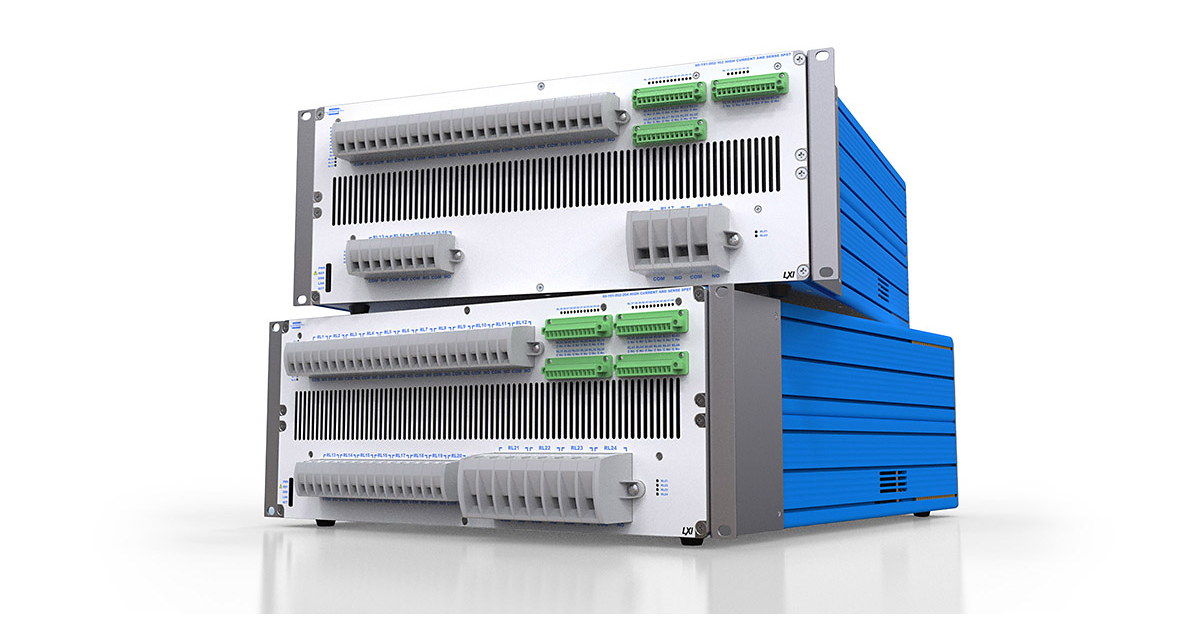
Pickering Interfaces introduced its 60-191 family of LXI-controlled, hermetically sealed relay/contactors (up to twenty 40A contactors plus four 80A contactors and complementary 1A relays) designed for automated high-current PSU switching. The units store up to 5,000 predefined switching sequences and execute them via software or configurable hardware triggers over an LXI 1.5 1000Base-T Ethernet interface, targeting faster integration and lower system latency. The release is positioned as a maintainable alternative to custom switching assemblies and includes a three-year warranty, with applications spanning EV battery, fuel-cell/hydrogen research, energy storage, and aerospace development.
The incremental economic signal is not a new end-market; it is a packaging shift that lowers integration friction in high-current test racks. That tends to help test-system vendors with software/service pull-through and hurt smaller custom panel builders and one-off integrators whose edge is bespoke wiring and commissioning labor. If standardized controllers reduce setup time and maintenance downtime, the mix shift is toward faster deployment and more repeatable installs, which is modestly favorable for recurring software, calibration, and field-service revenue rather than pure hardware margin.
The nearer-term catalyst is procurement behavior over the next 1-3 quarters: battery labs, inverter OEMs, and energy-storage test houses may be more willing to approve capex when commissioning cycles are shorter and relay life is instrumented. The second-order effect is that this can accelerate replacement of legacy contactor assemblies, but only if customers are already budgeted for EV/hydrogen testing; it does not create demand in a weak capex environment. If industrial capex rolls over or EV test spending slows, the product likely becomes a maintenance/up-sell story rather than a growth inflection.
Contrarian view: the market can over-interpret product launches as proof of secular demand acceleration. In reality, this looks like share-defense and workflow optimization, not a category expansion event. The more important question is whether Pickering’s installed base and software ecosystem increase switching costs; if not, this is largely a feature catch-up and the competitive moat remains narrow. For public-market exposure, the clean read-through is limited and any trade should be treated as a conditional monitor, not a conviction catalyst.
AI-powered research, real-time alerts, and portfolio analytics for institutional investors.
Request DemoOverall Sentiment
neutral
Sentiment Score
0.05
