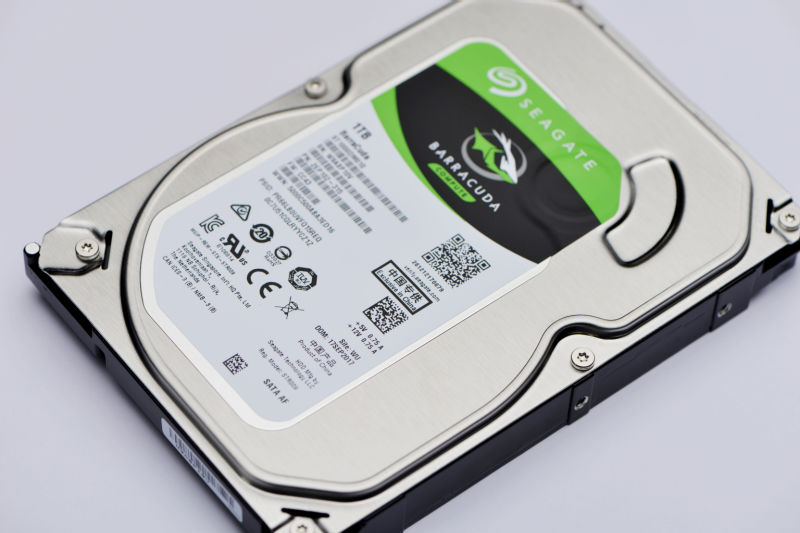
BofA raised its Seagate price target to $840 from $700 while reiterating a Buy rating after strong Q3 results and Q4 guidance that both beat expectations. Seagate reported revenue of $3.12B and EPS of $4.10 versus consensus of $2.95B and $3.50, and guided June-quarter revenue/EPS to $3.45B/$5.00 versus $3.16B/$3.96. Demand tied to AI infrastructure, tight HDD supply, and nearline capacity nearly fully allocated through calendar 2027 support a positive multi-year outlook.
STX is morphing from a cyclical HDD supplier into a quasi-contractual capacity asset, and that changes the earnings duration materially. When nearline supply is effectively spoken for through 2027, the marginal driver becomes pricing discipline rather than unit growth, which should compress reported volatility and lift valuation multiples if management keeps execution tight. The second-order effect is that NAND-centric storage peers and cloud infrastructure buyers may face a slower-cost-down path than consensus assumes, especially if AI workloads keep shifting storage demand toward high-capacity, high-reliability media.
The market is probably underappreciating how much of the upside is now in cash flow conversion rather than revenue growth. A business with locked-in configs and improving mix can generate an outsized free-cash-flow step-up even if end-demand cools, because the main risk moves from volume to customer concentration and contract repricing. That also means the stock’s biggest vulnerability is no longer demand elasticity; it’s any sign that the current supply bottleneck eases faster than expected or that hyperscalers push back on the next round of price resets.
The consensus is leaning hard into a straight-line AI/storage supercycle, but the better read is that this is a supply-led rerating with a finite runway. Once the market fully prices 2027 visibility, multiple expansion becomes harder unless the company can prove another leg of capacity/technology leverage beyond current assumptions. In that sense, the move is partly justified but increasingly crowded; the asymmetry shifts from chasing the name to monetizing it into strength or using call spreads rather than outright equity exposure.
Morgan Stanley is a clean read-through beneficiary in sentiment terms, but the real opportunity is in expressing relative value across semis and storage hardware rather than owning the crowded beta outright. If AI spend remains intact, STX should continue to outperform on estimate revisions and margin revision momentum; if AI budgets wobble, the stock could de-rate quickly because expectations already embed a very strong multi-year trajectory.
AI-powered research, real-time alerts, and portfolio analytics for institutional investors.
Request DemoOverall Sentiment
strongly positive
Sentiment Score
0.72
Ticker Sentiment
