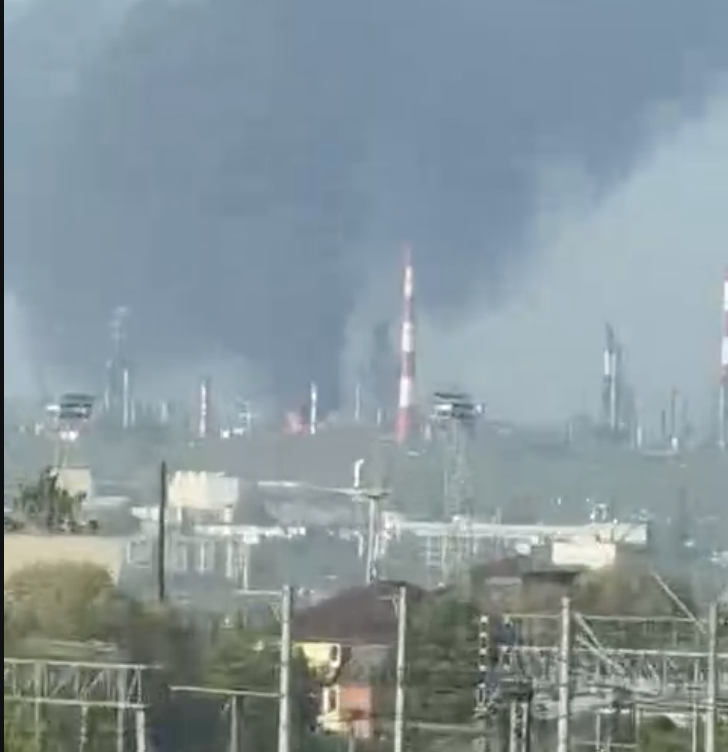
Ukraine said it struck Russia's Syzran oil refinery, more than 800 kilometers from the border, calling it another long-range sanction against Russia's oil refining sector. The article also reports alleged nuclear warhead transfers to Belarus for joint exercises, a Ukrainian strike on an FSB headquarters in occupied Kherson Oblast that Zelensky said killed and wounded about 100 Russian troops and destroyed a Pantsir-S1 system, and a Russian drone attack on Dnipro that injured at least 15 people. The developments reinforce war escalation risks for Russian energy infrastructure and regional security.
The market implication is less about headline oil supply disruption and more about a rising persistence premium on Russian refined-product logistics. Repeated strikes on refining and military fuel nodes force Russia to spend scarce air-defense inventory at multiple layers, which is a slow bleed on both throughput and transport reliability; that combination tends to widen the discount on Russian crude and products even if global Brent barely moves. The second-order beneficiary is not crude per se, but non-Russian product exporters and refiners with spare utilization in Europe, the Middle East, and India, because diesel and jet tightness can emerge regionally before it shows up in headline oil benchmarks.
The anti-access angle also matters: if Ukraine keeps demonstrating deep-strike reach, Russia will be pushed to harden, disperse, and reroute energy infrastructure rather than simply repair it. That is inflationary for maintenance capex, rail/pipe bottlenecks, and insurance/freight costs, which can tighten product availability over a multi-month horizon even without a major permanent outage. The broader geopolitical escalation risk from nuclear signaling raises tail risk for European defense and security spending, but the more immediate tradable effect is higher volatility in energy and defense proxies rather than a clean directional move in commodities.
Contrarian view: the consensus may be overestimating the chance that these strikes create a sustained global crude squeeze. Russia has shown an ability to absorb localized refining damage by shifting crude exports, rerouting product flows, and prioritizing military demand, so the first-order price impact may fade quickly. The underappreciated winner may be aviation and trucking outside Russia if refined-product exports tighten regionally; diesel cracks could outperform Brent if the market starts pricing in a slower recovery in Russian product output.
AI-powered research, real-time alerts, and portfolio analytics for institutional investors.
Request DemoOverall Sentiment
moderately negative
Sentiment Score
-0.35
