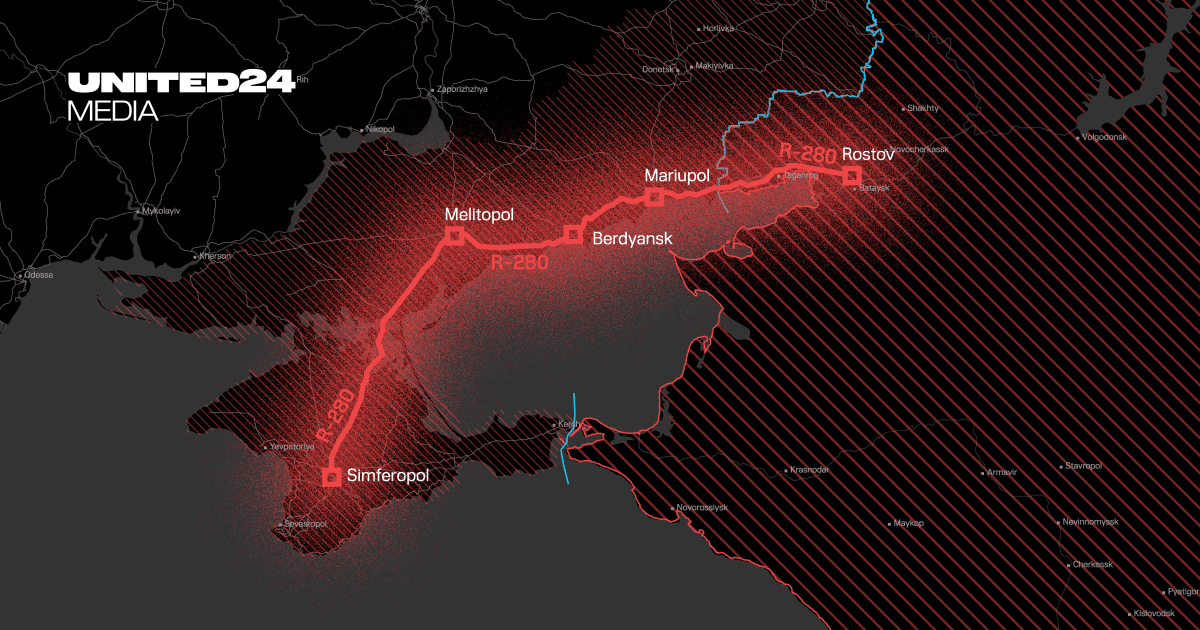
Ukraine’s 412th Nemesis Brigade says it is using previously undisclosed long-range strike drones to hit Russia’s R-280 Mariupol–Melitopol–Simferopol corridor, a key logistics route to Crimea. The unit claims dozens of Russian trucks and fuel tankers have been destroyed, forcing restrictions on heavy equipment movement along the highway. The reported disruption raises operational risk for Russian supply chains supporting occupied southern Ukraine and Crimea.
The marginal economic effect here is not the drone itself but the forced rerouting and inventory buffering it creates. Once a ground corridor becomes intermittently unreliable, the system-level cost rises nonlinearly: fuel, ammo, and repair assets must move in smaller convoys, under escort, with higher dwell times and larger safety stock in the rear, which reduces effective throughput even if physical road capacity is unchanged. That is a classic logistics strangulation pattern, and it tends to compound over weeks rather than days because operators need time to re-map routes, harden depots, and rebuild dispatch confidence. The second-order winner is any segment of the defense stack that monetizes persistent electronic-warfare-resistant autonomy: fixed-wing drones, seekers, navigation software, comms-hardening, and expendables. The loser set is broader than Russian trucking units; it includes fuel distribution, field maintenance, and any force element relying on just-in-time replenishment in southern theater. A subtle implication is that attrition on logistics assets can outpace attrition on frontline combat vehicles in strategic value, because one destroyed tanker can idle multiple downstream systems and create localized fuel scarcity far from the blast radius. For markets, the direct read-through is to Ukraine-linked unmanned systems suppliers and, more broadly, Western defense names with exposure to loitering munitions, counter-UAS, and secure navigation. The move is likely underappreciated in that investors often treat drone strikes as tactical headlines rather than a structural increase in the cost of occupation. The main reversal risk is adaptation: dispersion, decoys, night movement, and more robust air defenses can compress the effectiveness of the campaign over 1-3 months, but that typically raises Russian logistics costs before it restores prior efficiency.
AI-powered research, real-time alerts, and portfolio analytics for institutional investors.
Request DemoOverall Sentiment
mildly negative
Sentiment Score
-0.35
