
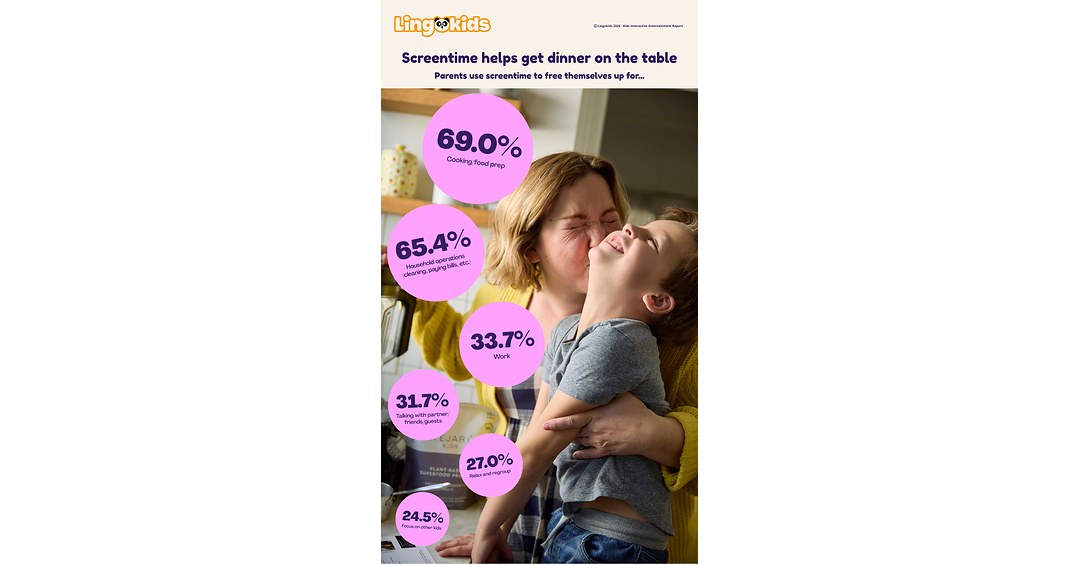
Lingokids’ Kids Interactive Entertainment Report finds 69.0% of parents say kids’ screen time frees them up for cooking/food prep and 65.4% for household operations, with only 33.7% citing work. The report also says the top reason parents override screen-time limits is to finish a task. The article is primarily consumer-behavior research with no direct earnings or financial figures, implying limited near-term market impact.
This is a modestly constructive signal for curated kids-content platforms, but not a standalone earnings catalyst. The economic mechanism is not “more screen time,” it’s lower parental friction: if screen use is viewed as household infrastructure, then retention should be driven by trust, repeatability, and convenience rather than premium content alone. That favors platforms with strong kid-safety positioning and simple onboarding; it is only a second-order positive for DIS because family households are more likely to tolerate a broader bundle and to keep kids’ profiles active.
The bigger read-through is competitive: the pressure is on ad-supported, open-loop kid environments where parents must supervise or second-guess content. Over 6–18 months, that can support premiumization for curated offerings, but the monetization path is uncertain unless those platforms can convert trust into higher ARPU or lower churn. For Disney, this is more of a moat maintenance data point than a growth inflection; kids engagement helps bundle stickiness, but it doesn’t meaningfully change the company’s exposure to streaming pricing, ad-tier fill, or parks-driven multiple.
Contrarian view: the market may overvalue the “educational” framing and undervalue pure utility. Parents are not buying pedagogy first; they are buying time, which means the winners are the least-friction products, not necessarily the most acclaimed ones. Falsifier: if Disney+ family churn, kids-profile minutes, or bundle retention deteriorate in the next 1–2 quarters, this trust tailwind is not translating into monetization and the read-through should be ignored.
AI-powered research, real-time alerts, and portfolio analytics for institutional investors.
Overall Sentiment
neutral
Sentiment Score
0.08
Ticker Sentiment
