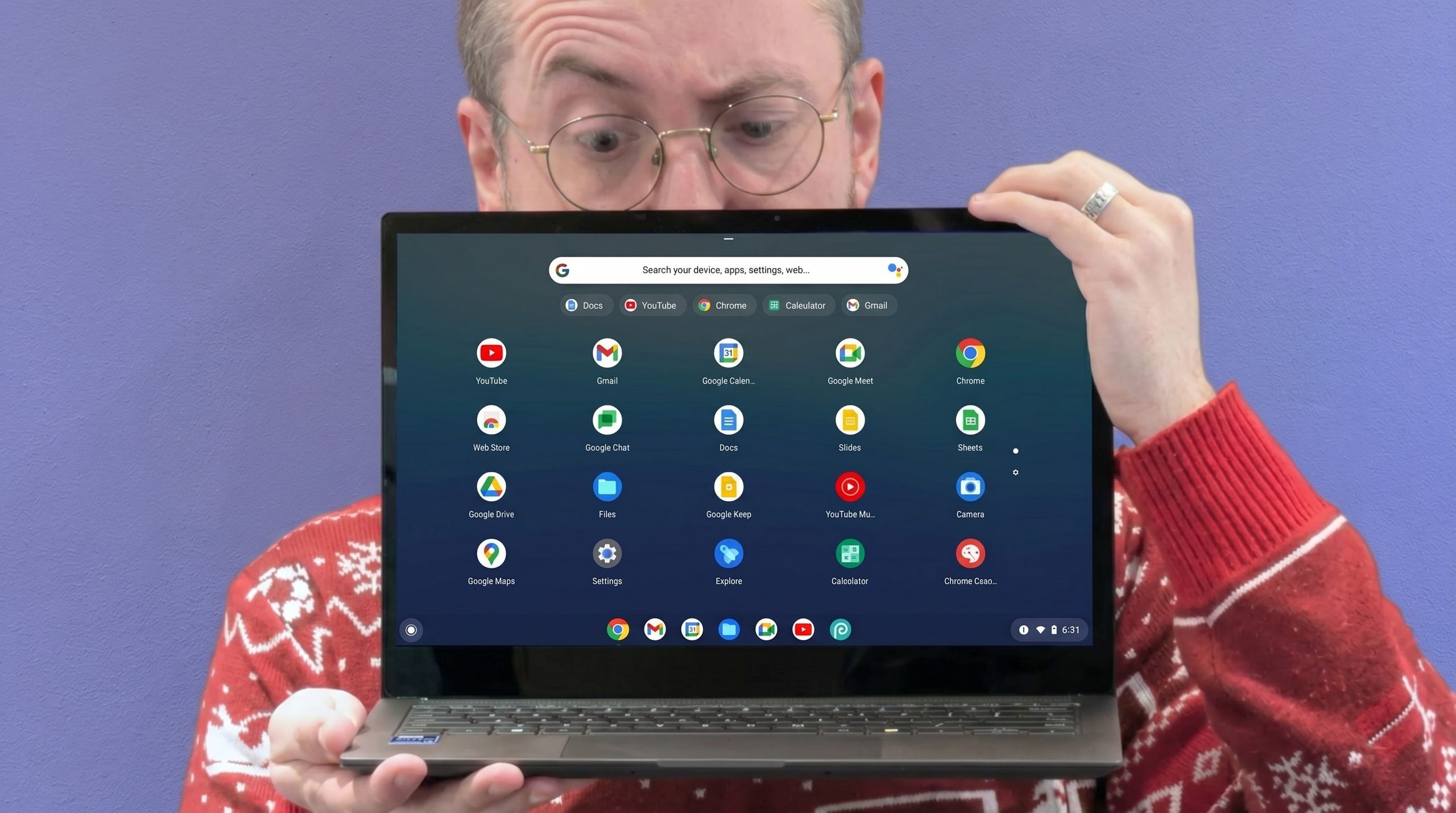
Google’s move to bring full Android apps to Chrome OS is presented as a strategic step that could strengthen Chromebooks, especially in schools, where more Chromebooks were sold in Q1 2016 than all of Apple’s OS X, at roughly 2 million units. The article frames this as a long-term competitive challenge for Microsoft, but the piece is mostly forward-looking commentary rather than a direct market-moving announcement. The key takeaway is ecosystem convergence: Google has 1.5 million Android apps and is using Chrome OS to deepen user adoption.
The incremental bull case here is not about a single product feature; it is about Google tightening the switching costs around the user identity layer. If Android-class workflows move from phones to PCs, Google gains a higher-frequency surface for Search, Ads, Drive, and Gemini-style mediation, while Microsoft risks being pushed from the default work surface into a just-another-app role. That matters because the profit pool is no longer the OS license itself, but control over where intent, automation, and authentication live.
The second-order loser is Windows hardware differentiation. If low-cost Chromebooks/Android PCs become “good enough” for education and light enterprise, OEM mix can shift toward cheaper, thinner devices with lower ASPs and weaker attach economics for Microsoft-linked software/services. That is mildly negative for MSFT’s endpoint gravity, but more importantly it pressures the ecosystem of Windows-first peripherals, support contracts, and legacy enterprise upgrade cycles over a multi-year horizon.
QCOM is the clearest clean beneficiary if this thesis broadens beyond browsers and into agentic, always-on, ARM-based client computing. The market often treats PC ARM adoption as a cyclically noisy story, but the real upside is architectural: if Google normalizes mobile-native computing on the desktop, Qualcomm gets a larger served market and better justification for premium client silicon, modem, and NPU content. AAPL is more insulated; its risk is not share loss but the possibility that Google validates a cross-device assistant paradigm that compresses ecosystem lock-in at the margin.
The contrarian view is that this is still a feature-velocity story, not a conversion story. Education has been won before without translating into durable consumer or enterprise share, and Windows’ biggest moat remains backward compatibility plus admin inertia. The catalyst path is long: days matter only if product announcements shift expectations, but the real test is 12-24 months of app quality, enterprise manageability, and OEM breadth. If Google fails on any one of those, the market will keep assigning this to the “interesting alternative OS” bucket rather than a real MSFT share threat.
AI-powered research, real-time alerts, and portfolio analytics for institutional investors.
Request DemoOverall Sentiment
neutral
Sentiment Score
0.15
Ticker Sentiment
