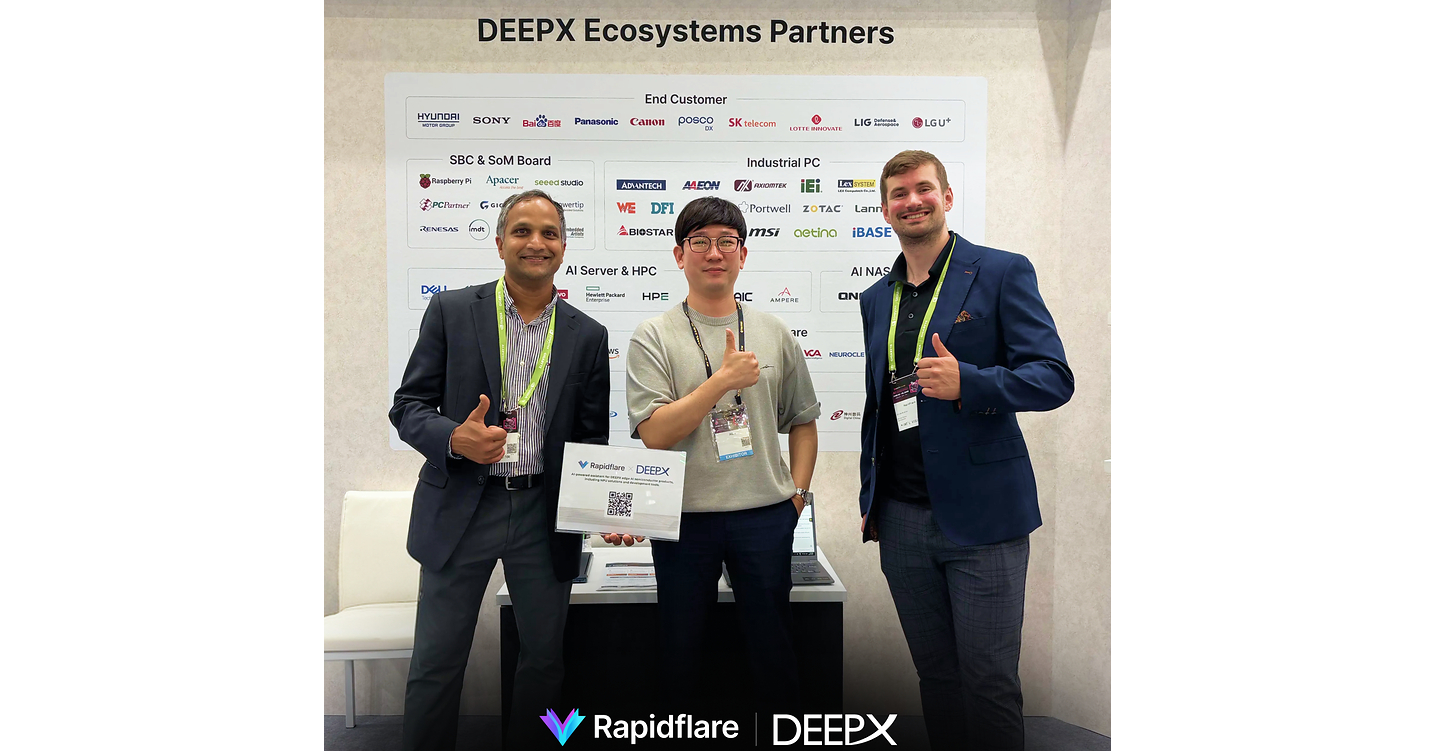
Rapidflare announced a strategic partnership with DEEPX to deploy Rapidflare’s agentic AI “trusted product intelligence layer” across DEEPX’s developer ecosystem, unifying GitHub and DXNN® SDK documentation into real-time, source-cited operational guidance for edge AI/robotics. The integration is described as fully live today within DEEPX’s technical support and developer enablement systems, with a roadmap to connect documentation to real-world operational feedback and enable automated troubleshooting/self-diagnosis at the edge. Overall, this is a product/partnership expansion with limited near-term financial implications, but it strengthens go-to-market and developer enablement for DEEPX’s DX-M1 and DX-M2 NPUs.
This is directionally positive for the edge-AI ecosystem, but the monetization path is much more about lower customer-acquisition friction and cheaper support than immediate silicon revenue. If the integration actually reduces deployment time and field-debug cycles, the first beneficiaries are smaller NPU vendors and OEMs that need developer mindshare; the second-order winner is the broader industrial/robotics stack because easier onboarding raises the probability of real deployments, not just pilots.
The market should not extrapolate this to near-term unit growth. For public comps, the read-through is modestly constructive for edge-AI enablers such as QCOM, ARM, and NVDA only insofar as it reinforces that the market is moving from benchmark wars to ecosystem wars. Over 6-18 months, the real value accrues to vendors with the deepest installed base and strongest developer tooling; a thin layer of support automation by itself does not create a moat unless it measurably improves conversion, retention, or service margins.
Contrarian view: this is likely more table-stakes than differentiated product advantage. The consensus may be overpricing the strategic importance of a partnership announcement that is still unproven in hard KPIs; until we see support-ticket deflection, lower cost-to-serve, or faster design-win conversion, it should be treated as a proof-of-concept rather than a fundamental step-change. The main falsifier is simple: if the next 1-2 quarters do not show measurable developer engagement or margin leverage, the thesis is dead and this becomes non-event noise.
AI-powered research, real-time alerts, and portfolio analytics for institutional investors.
Request DemoOverall Sentiment
mildly positive
Sentiment Score
0.25
Ticker Sentiment
