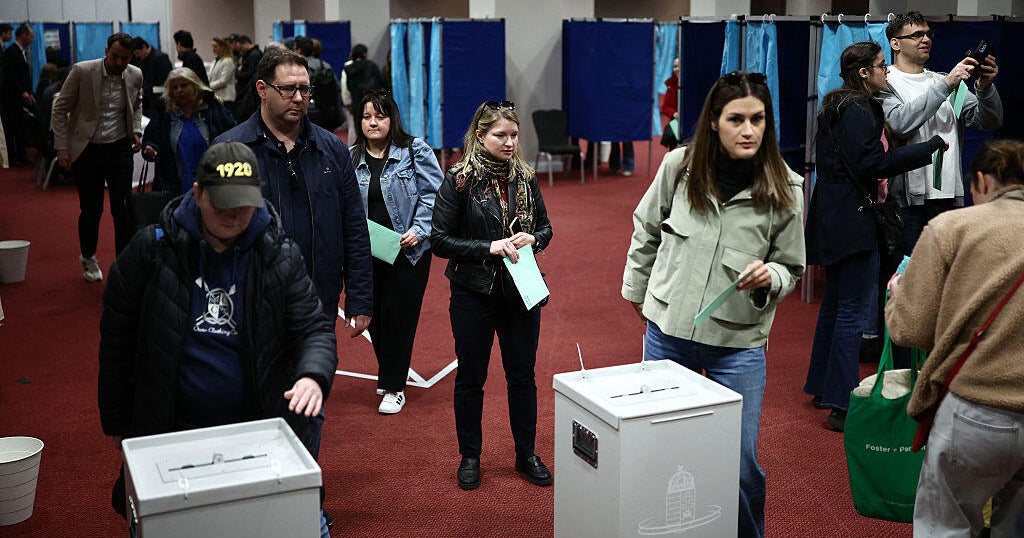
Hungary held a high-stakes national election that could unseat Prime Minister Viktor Orbán, with polls showing record turnout of 54.14% after the first five hours and roughly 997,000 more voters than at the same point in 2022. The race centers on Orbán’s pro-Russia, Trump-aligned government versus challenger Péter Magyar, with issues including corruption, democratic institutions, and Hungary’s geopolitical orientation. The article is politically significant but carries limited direct market impact absent election results or policy changes.
The immediate market read is not about Hungary as a standalone economy; it is about the probability distribution of policy friction inside the EU. A credible shift away from Orbán would improve the odds of smoother EU fund disbursement, lower headline sovereign-risk premium, and less idiosyncratic noise around Hungarian assets, but the bigger second-order effect is on regional risk sentiment: investors often use Hungary as a proxy for how much political fragmentation Europe can tolerate before it becomes investable only at a discount.
The main near-term catalyst is not the vote itself but the post-vote narrative on legitimacy and governability. A tight result or delayed concession would keep the “policy paralysis” trade alive for days to weeks, while a clear change mandate could trigger a relief rally in domestically exposed financials, utilities, and property-linked names via lower discount rates and better access to EU transfers. The reverse risk is equally important: if Orbán survives, markets may initially shrug, but a renewed standoff with Brussels would keep the medium-term overhang on funding costs and capex visibility for Hungarian corporates for months.
Consensus may be overestimating the binary nature of the outcome. Even if the incumbent loses, institutional inertia and coalition complexity can blunt the policy reset, so the tradable move may be smaller than the headline implies. Conversely, if he wins, the market may underprice how much this entrenches a broader Central/Eastern Europe governance discount, especially for countries and sectors that are sensitive to EU capital allocation and rule-of-law screening.
From a cross-asset lens, this is a relative-value event rather than a clean directional macro trade. The best risk/reward likely sits in hedged exposure to a post-election compression of Hungary’s governance discount, while using broader Europe as a hedge against a false breakout in sentiment.
AI-powered research, real-time alerts, and portfolio analytics for institutional investors.
Request DemoOverall Sentiment
neutral
Sentiment Score
0.00
