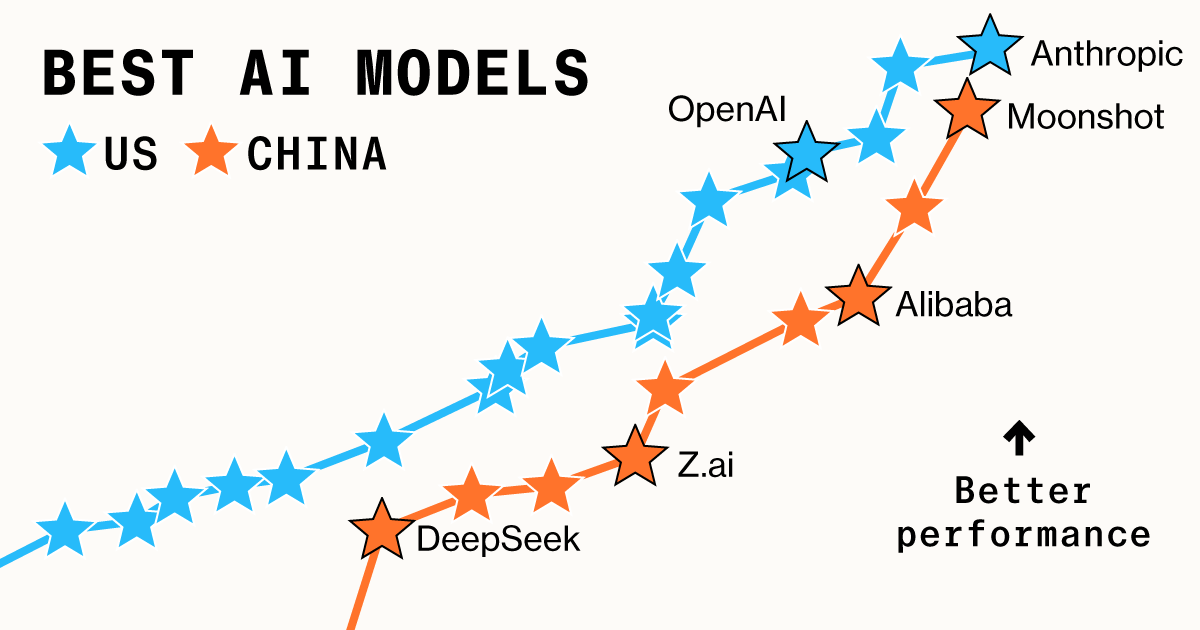
The article highlights China’s AI models closing the gap with the US, with Kimi K3 nearly matching Anthropic’s frontier capability at a much lower cost ($15 per million output tokens vs $50 for Anthropic’s Fable 5). Usage has shifted overseas—Chinese models accounted for over 60% of market share on OpenRouter last month and 41.4% of generative model downloads on Hugging Face (+5pp vs US models). US policy risk is rising as Trump administration officials weigh potential restrictions on Chinese (open-weight) models that nearly 200 US companies oppose, while US labs face pressure in pricing and profit models (analyst view: over-supplied sector likely remains loss-making for ~3 years).
The market implication is not that one side “wins AI,” but that model capability is converging fast enough to make inference a commodity. That shifts value from proprietary model IP toward distribution, workflow ownership, and whoever can absorb lower unit costs into higher usage. Public equities most exposed to that deflation are companies with heavy AI consumption in customer support, logistics, code generation, or fraud ops; public beneficiaries are the firms that can turn cheaper intelligence into faster product velocity without having to defend an expensive model stack.
The cleaner medium-term beneficiary set is the China cloud/AI buildout complex, where state-backed capex and open-weight adoption can translate into higher utilization across BABA and TCEHY even if model-level economics stay ugly. The more important second-order effect is that cheaper Chinese models reduce the urgency of paying premium prices to US frontier labs, which should pressure the narrative premium in the private AI ecosystem and, by extension, the listed megacap platforms that are spending heavily to stay in the race.
Near term, the key catalyst is policy: any US restriction on Chinese models would likely be self-defeating for domestic adopters and would mostly raise costs, not restore a moat. Over 1-3 months, watch whether enterprise AI budgets reprice toward lower-cost open-weight stacks; over 6-18 months, the real risk is that the AI spend curve becomes more elastic, which is bullish for adoption but bearish for pricing power and valuation multiples in the highest-expectation names. The contrarian miss is that “China catching up” can be deflationary for the entire AI stack while still being positive for software margins outside the frontier labs.
AI-powered research, real-time alerts, and portfolio analytics for institutional investors.
Request DemoOverall Sentiment
mixed
Sentiment Score
-0.20
Ticker Sentiment
