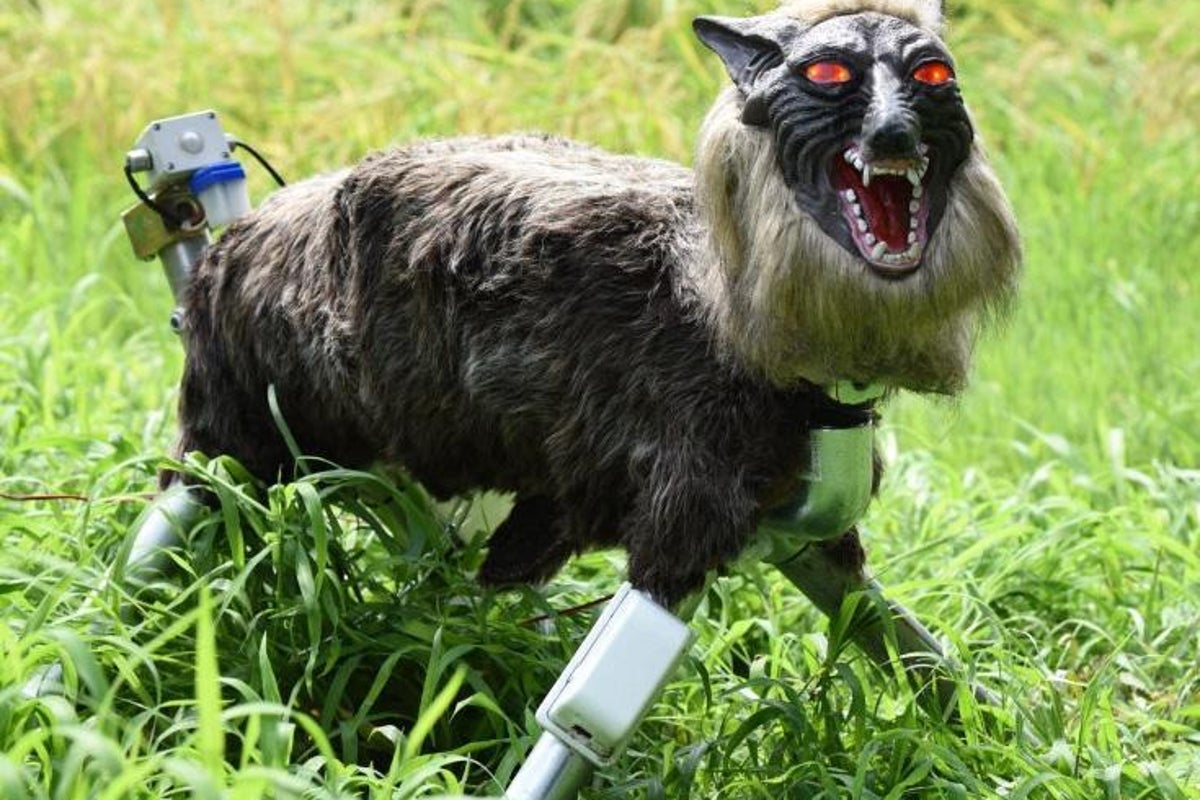
Ohta Seiki has received about 50 orders this year for its 'Monster Wolf' animatronic scare device, above a typical full-year volume, with customers facing a two- to three-month wait. The surge reflects record bear attacks in Japan, including 13 fatal attacks in 2025-2026 and more than 50,000 sightings, driving demand from farmers, golf operators and rural workers. The company is upgrading the product and exploring AI camera-enabled future models.
This is less a novelty story than a localized capex cycle in rural risk mitigation. The immediate winners are the small number of manufacturers that can produce physical deterrence hardware, but the bigger second-order beneficiaries are suppliers of sensors, batteries, solar components, embedded audio, and low-cost edge AI that can be modularized into outdoor security products. Because the product is hand-built today, the near-term constraint is not demand but throughput; that creates a classic bottleneck where pricing power can persist for 2-4 quarters even if unit demand normalizes.
The more important implication is that Japan’s wildlife problem is forcing adoption of tech that sits between security, agri-tech, and public safety. If even a fraction of the current orders are upgraded from standalone scare devices to camera-linked, networked systems, the spend per site can expand meaningfully and pull through recurring software/service revenue. That shifts this from a one-off novelty purchase to a maintenance and monitoring budget line, which is a much larger and stickier market.
The contrarian read is that the market may overestimate how scalable this niche is. A record-sighting headline can drive panic buying, but bear mitigation is highly seasonal and geographically concentrated, so growth may decelerate sharply after the next hibernation cycle unless attacks remain elevated. There is also substitution risk: municipalities and farms may eventually prefer cheaper fencing, traps, insurance, or human patrols over a premium device if efficacy is inconsistent, which would cap the medium-term addressable market.
For public markets, the investable angle is not the wolf itself but the broader Japan outdoor-security and smart-camera stack. The best asymmetric setup is to buy names exposed to low-power sensors, vision AI, and ruggedized IoT in Japan/Asia while avoiding pure novelty hardware plays that cannot scale manufacturing. If the company’s AI-camera upgrade lands, the catalyst window is 6-12 months; if not, the current demand spike is likely to fade within 1-2 bear seasons.
AI-powered research, real-time alerts, and portfolio analytics for institutional investors.
Request DemoOverall Sentiment
mildly positive
Sentiment Score
0.20
