





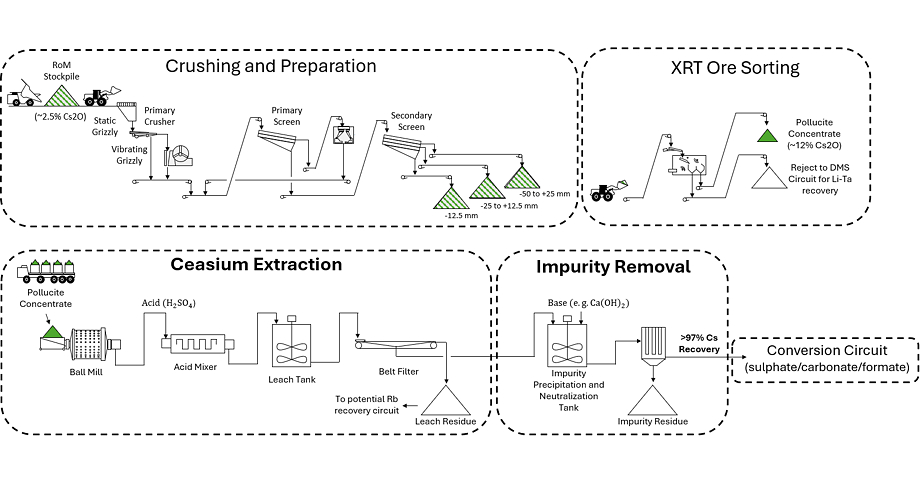
PMET reports bench-scale caesium extraction results from pollucite concentrate, achieving >97–98% Cs recovery into solution using sulphuric acid leaching at up to 120°C, while successfully removing key impurities (e.g., aluminum) with negligible Cs losses. The company is running parallel testwork with Koch Technology Solutions, where Phase 1 preliminary results show selective, high loading-factor Cs recovery using Koch’s proprietary flow sheet (leveraging both synthetic and live pregnant leaching solutions). Next steps target gram-scale production of high-purity caesium salts/carbonates (Cs-sulphate, Cs-carbonate, Cs-formate) and potentially Rb-carbonate, with expected further results around Q4 2026 alongside a broader PEA and CV5 feasibility work scheduled for Q4 2026.
This is incrementally bullish for PMET, but mostly as a de-risking event rather than a monetization event. Bench-scale recovery above 97% tells the market the caesium circuit is not obviously broken; it does not yet prove recoverable dollars per tonne, reagent intensity, product spec, or whether downstream qualification will support premium pricing. In our frame, the near-term effect is a modest reduction in technical discount on the CV13 optionality, while the real valuation debate remains whether caesium is a meaningful second-order NPV driver or simply a nice byproduct credit.
The key second-order read-through is that PMET is trying to turn a lithium/tantalum project into a multi-commodity platform, which can lift the multiple only if investors believe the caesium stream lowers unit costs or funds capex. That can help sentiment versus other junior lithium names, but it also raises execution complexity: more circuits, more QA/QC, more permitting surface area, and more ways for the PEA to disappoint. If the Q4 2026 PEA shows caesium adds only a small fraction of project value, the current enthusiasm will likely fade quickly.
Contrarian view: the market may be overweighting the phrase "world’s largest" and underweighting the fact that specialty-chemical optionality is only valuable once reproducible at scale with a bankable off-take path. The tradeable catalyst path is not this release; it is the PEA and any proof-of-concept product samples. Falsifiers are simple: if the PEA lands with de minimis caesium contribution, materially higher capex/opex, or no clear route to gram-scale product qualification, the caesium thesis should be discounted back to zero.
AI-powered research, real-time alerts, and portfolio analytics for institutional investors.
Request TrialOverall Sentiment
mildly positive
Sentiment Score
0.25
Ticker Sentiment
