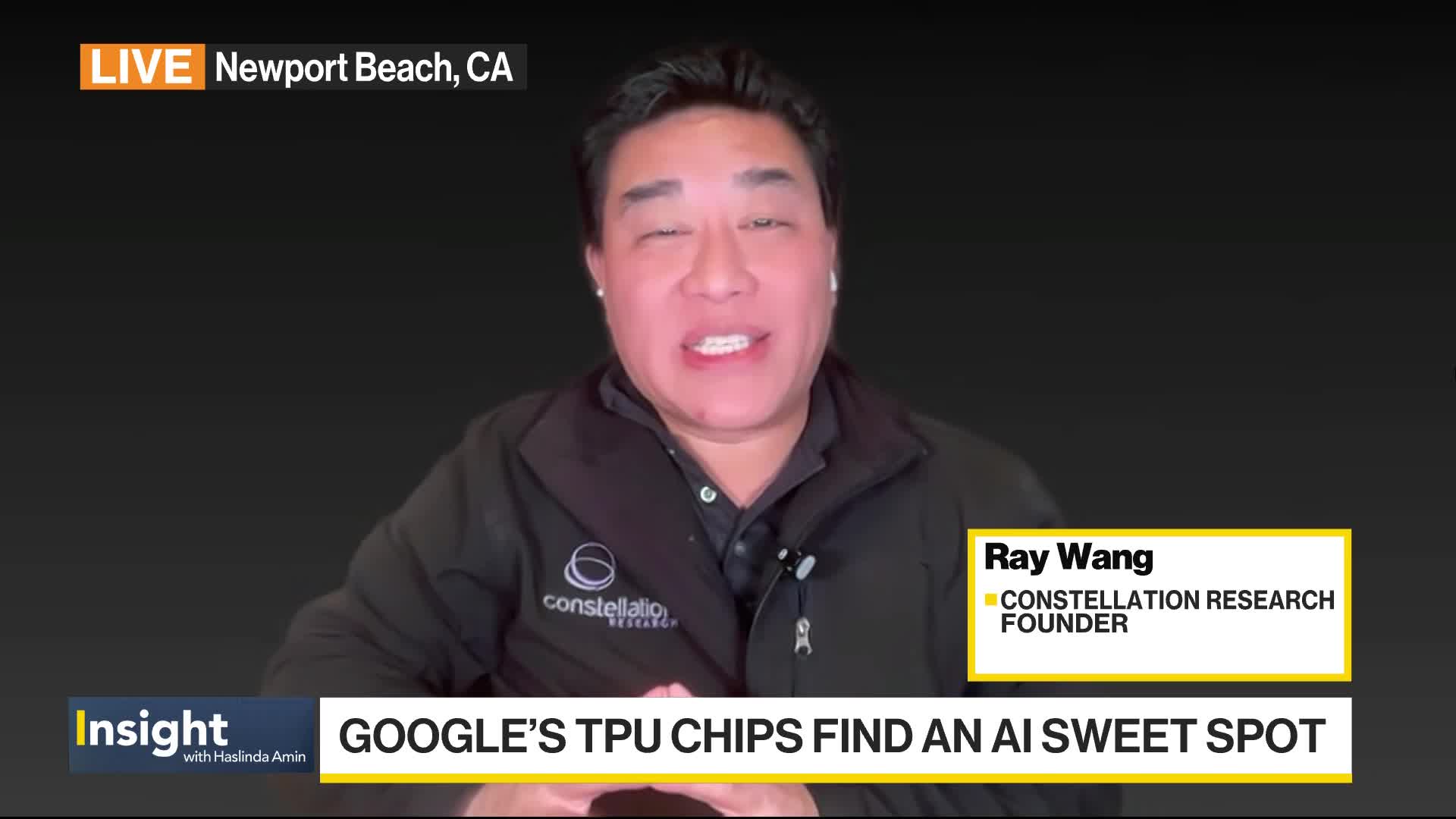
Google's purpose‑built TPUs and vertically integrated "chip-to-app" stack are positioned to challenge NVIDIA's GPU dominance by offering more power‑efficient, lower‑cost AI training and inference options, driving hyperscaler and enterprise chip diversification. Gemini 3 is presented as competitive with leading LLMs, supporting demand for Google's full‑stack offering, while analysts forecast a very large addressable AI market — roughly $7 trillion by 2030 — and model NVIDIA potentially peaking around $6.5–7 trillion market cap as sovereign and physical AI investment accelerates. The discussion implies material secular upside for AI infrastructure players but also near‑term volatility (recent share weakness and activist scrutiny were noted), suggesting strategic reallocations across cloud, chipmakers (AMD, Samsung, SK Hynix, TSMC) and software stacks.
Market structure: Google (GOOGL) and hyperscalers that vertically integrate TPUs win on unit economics for inference and cost-sensitive training — expect Google Cloud GPU/TPU mix to recapture 5–15% incremental cloud gross margin over 12–24 months. NVIDIA (NVDA) retains pricing power for high-end training; article’s $7T TAM by 2030 implies multi-year demand that sustains premium multiples even if near-term share shifts occur. HBM suppliers (TSM, HIMX) and foundries (TSM) see tighter supply and pricing power; smaller GPU vendors and legacy on-prem incumbents risk margin compression.
Risk assessment: Tail risks include export controls or Taiwan supply shock (low probability, high impact: >30–50% drawdown for TSM/NVDA), and aggressive antitrust action against hyperscalers/vertical integration. Near-term (days–weeks) risk is sentiment-driven volatility (Catalyst: Q3 cloud capex comments); medium-term (3–12 months) risk is slower TPU adoption due to software lock-in (CUDA) and HBM shortages; long-term (12–36 months) execution risk is slower monetization of Google’s stack. Hidden dependency: developer ecosystem stickiness (CUDA) can materially delay TPU share gains unless Google funds migration tools.
Trade implications: Tactical longs — overweight GOOGL and NVDA on dips but size positions to volatility: initiate 2–3% GOOGL long; use 12–18 month NVDA LEAPS call-spread (buy ATM, sell 1.5x OTM) sized 1–2% notional to cap premium. Relative value — pair long GOOGL vs short ORCL (1.5:1) for 6–12 months waiting for cloud AI share shift; overweight TSM/semicap suppliers (1.5–2% each) to play HBM scarcity. Timing: initiate starters now, add on drawdowns: +8% pullback for GOOGL within 8 weeks, +15% retrace for NVDA within 4–12 weeks; target exits at +30–50% or re-evaluate at 12–18 months.
Contrarian angles: Consensus underestimates friction from software lock-in — TPU revenue may ramp slower than hardware wins imply; conversely NVDA sell-offs likely overdone relative to structural demand (so a limited, staged long is warranted). Historical parallel: ASICs in crypto displaced GPUs quickly once tooling matured — if Google funds migration tools, TPU adoption could accelerate nonlinearly (6–24 months). Unintended consequence: sovereign AI capex could inflate semicap cycles and wages, worsening supply shortages and favoring suppliers over end-system OEMs.
AI-powered research, real-time alerts, and portfolio analytics for institutional investors.
Request DemoOverall Sentiment
moderately positive
Sentiment Score
0.45
Ticker Sentiment
