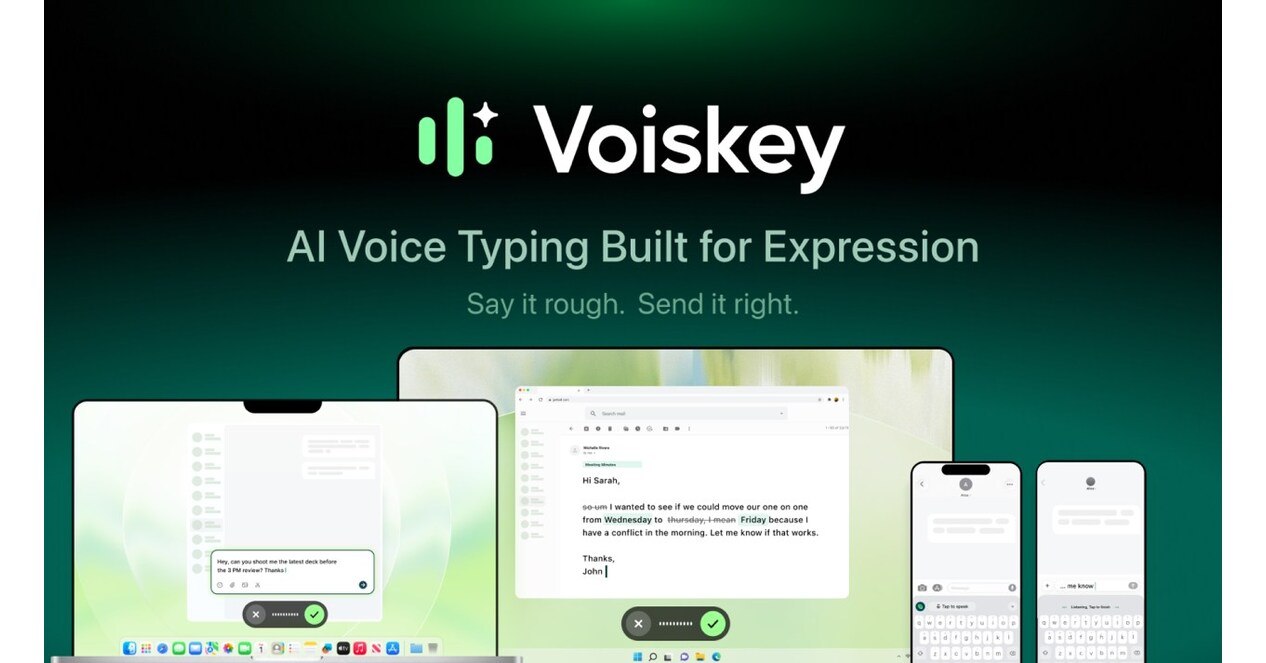
Voiskey officially launched globally its AI voice typing app powered by a proprietary “Expression Intelligence” model, converting spontaneous speech into context-aware polished text. The company cites a 5× average efficiency improvement vs. traditional keyboard typing during its private beta (1,000 participants) and supports English/Japanese optimizations plus real-time translation across 100+ languages. Desktop (Mac/Windows) and mobile (iOS/Android) clients are now available via voiskey.ai/App Stores, suggesting a constructive innovation signal for the AI voice interface segment, though without direct financial metrics.
This is less a monetizable product launch than a signal that voice is moving from transcription to interface-layer software. The durable winners are the platforms that can bundle permissioning, context access, and distribution into the OS or productivity suite; standalone voice apps are structurally vulnerable to feature compression once the underlying model stack becomes cheap. That makes AAPL and GOOGL the relevant proxies, but only as option value on broader AI-UX adoption rather than as direct beneficiaries of this specific release.
GOOGL has the cleaner path to monetization if context-aware voice sticks, because it can attach the workflow to search, Android, Chrome, and Workspace and potentially improve session frequency and ad surfaces. AAPL benefits more defensively: if voice becomes a mainstream input method, its ecosystem control and privacy framing matter, but the revenue translation is slower and mostly indirect. The biggest near-term loser is the long tail of niche dictation/startup tools, especially if enterprise IT decides active-window access and microphone permissions are too risky to approve broadly.
The key risk is that adoption is constrained by friction the launch cannot solve: speaking in public, compliance-sensitive environments, and the fact that dense editing still favors keyboards. In the next 1-3 months, the market should treat this as a feature test, not a category shift; the real catalyst is whether a platform owner ships the same capability natively. Over 6-18 months, the thesis is falsified if retention and paid conversion do not hold after the beta honeymoon, or if app-store/security review slows deployment of context-aware permissions.
AI-powered research, real-time alerts, and portfolio analytics for institutional investors.
Request DemoOverall Sentiment
mildly positive
Sentiment Score
0.25
Ticker Sentiment
