


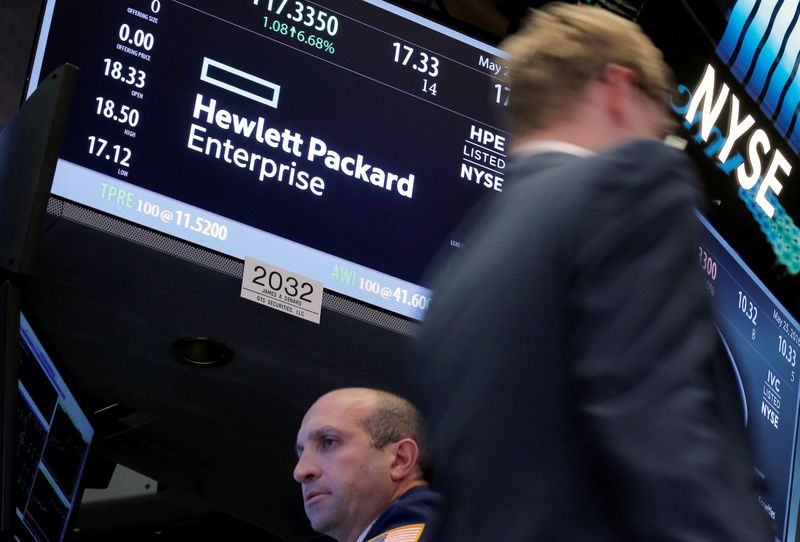
Hewlett Packard Enterprise posted record Q2 revenue of $10.68 billion, up 40% year over year and above the $9.79 billion consensus, while adjusted EPS of 79 cents beat the 53-cent estimate. The company raised fiscal 2026 revenue growth guidance to 29%–33% from 17%–22% and lifted adjusted EPS guidance to $3.35–$3.45 from $2.30–$2.50, with shares surging 36% in after-hours trading. HPE also introduced a fiscal 2027 framework calling for 8%–12% revenue growth and at least $4.5 billion in free cash flow, citing strong AI server and networking demand.
This prints as a multiple-revision event rather than a simple beat: management has effectively de-risked the next 12-18 months by pulling forward goalposts, which usually forces systematic underownership to re-rate quickly. The market should focus less on the quarter itself and more on the implied acceleration in backlog conversion for AI infrastructure, because that tends to create a multi-quarter revenue comp tailwind even if end-demand normalizes.
The second-order winner is the AI hardware ecosystem beyond HPE: stronger server and networking demand validates capex budgets across enterprise customers and increases urgency for adjacent spend on switches, optics, power, and rack-level infrastructure. The main loser is not just direct peers but any vendor relying on a “wait-and-see” replacement cycle; when CIOs see one incumbent pull forward guidance this aggressively, procurement teams often re-open budgets sooner, but the pie may not expand equally across all vendors, pressuring weaker execution stories.
The cleanest contrarian point is that the stock reaction may have already discounted a lot of the good news, but the estimate revision cycle is likely still early. The risk is that the market extrapolates a one-quarter surge into a structural margin step-up; if enterprise server demand slows while AI networking remains hot, growth quality can deteriorate over the next 2-3 quarters even if headline revenue stays strong. Any disappointment in free-cash-flow conversion or synergy timing would likely hit hardest once the enthusiasm cools.
For the broader complex, this is a read-through negative for slower-moving peers that depend on AI enthusiasm without near-term monetization proof. It also raises the bar for the next wave of enterprise AI spend announcements: after this print, investors will likely demand evidence of booked demand and cash generation, not just pipeline rhetoric.
AI-powered research, real-time alerts, and portfolio analytics for institutional investors.
Request TrialOverall Sentiment
strongly positive
Sentiment Score
0.84
Ticker Sentiment
