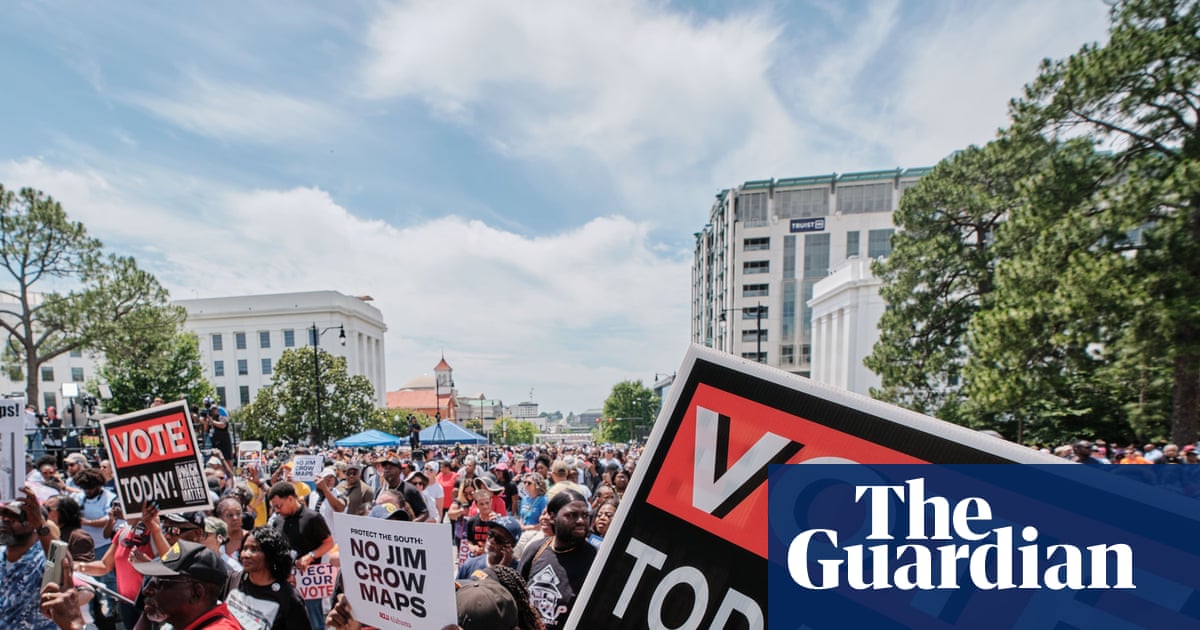
The article describes a large voting-rights rally in Montgomery following the Supreme Court's Louisiana v. Callais decision, which weakened Voting Rights Act protections and prompted Republican-led states to redraw maps. Tennessee and Florida have already passed new maps, while Alabama, Louisiana and Georgia may follow, with Mississippi pausing redistricting temporarily. The event reflects escalating political and legal conflict over election maps, but it is unlikely to have direct market-moving implications.
The immediate market read is not on election mechanics itself, but on the policy transmission channel: weaker voting protections raise the probability of more durable one-party control in several Southern states, which increases the odds of faster-moving state-level agendas on taxes, labor, utilities, education, and ESG-related regulation. That creates a subtle but real tailwind for regionally exposed issuers that benefit from lower state tax burdens and a more permissive regulatory backdrop, while increasing downside risk for companies reliant on demographic growth assumptions or federal-level civil-rights enforcement staying intact.
The second-order effect is on political volatility, not just outcomes. If redistricting battles intensify into court fights and voter mobilization campaigns, expect a multi-quarter rise in legal spend, ad spend, and grassroots mobilization budgets across both parties; that is supportive for media, political consulting, canvassing technology, and digital fundraising platforms, even if the underlying tone is negative. The bigger near-term catalyst is whether additional states finalize maps before the next legislative session cycle, which would extend uncertainty into 3Q–4Q and keep “policy risk premium” embedded in Southern municipal and regional financials.
The contrarian point is that markets may overestimate the permanence of the legal change. A counter-mobilization could force congressional or state constitutional responses over the next 6–18 months, and the issue itself tends to increase turnout among affected constituencies, which can partially neutralize map advantages. That means the cleanest expression is not a broad macro short, but a relative-value trade on beneficiaries of higher political spending versus names most exposed to Southern policy fragmentation.
For portfolios with regional sensitivity, the most actionable risk is a spike in litigation-driven uncertainty around infrastructure permitting and utility regulation in the South; those effects can hit project timelines before they show up in fundamentals. In that sense, the memo is less about immediate earnings and more about the probability distribution of state policy over the next election cycle.
AI-powered research, real-time alerts, and portfolio analytics for institutional investors.
Request DemoOverall Sentiment
mildly negative
Sentiment Score
-0.20
