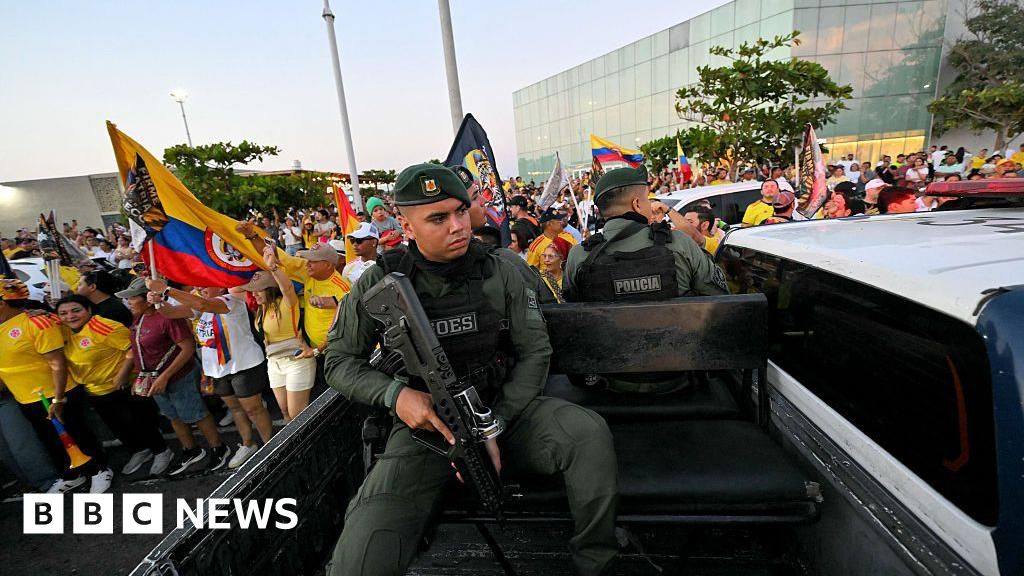
Colombia's presidential election is being shaped by escalating violence, forced displacement, extortion, bombings and clashes among armed groups, with illegal armed group membership roughly doubling over the past five years. Forced displacement reportedly rose 300% between 2024 and 2025, underscoring worsening security conditions tied to rising cocaine production and weak state control in rural areas. The two leading candidates offer sharply different approaches: Iván Cepeda backs negotiated security and Gustavo Petro's 'total peace' framework, while Abelardo de la Espriella is promising a hardline crackdown, 10 mega-prisons and an end to talks with armed groups.
This is a classic EM political-risk repricing event, but the more important market channel is not the election outcome itself — it is whether the next administration restores territorial control quickly enough to interrupt the financing loop between cocaine, illegal mining, extortion, and armed recruitment. If insecurity keeps rising, Colombia’s sovereign risk premium should stay sticky even if headlines fade, because the fiscal burden shows up through higher security spend, weaker tax compliance, and slower investment outside the main urban corridors.
The first-order losers are domestic cyclicals with exposure to rural logistics, construction, retail distribution, and discretionary consumption in the southwest and Pacific regions, where route security matters more than macro growth. The second-order loser is formal mining and infrastructure: even firms not directly attacked face higher insurance, convoy, and project-delay costs, which tends to widen the gap between headline capex announcements and actual execution over the next 6-12 months. Banks also become a lagging casualty as SME delinquency rises from extortion, business interruption, and displacement-driven demand destruction.
The contrarian takeaway is that a hardline victory would not be an immediate positive for risk assets if it simply increases kinetic pressure without restoring state presence in abandoned territories. That scenario usually lifts volatility before it improves fundamentals, because armed groups fragment, retaliation intensifies, and transport corridors remain disrupted. The better setup is any policy mix that pairs enforcement with visible territorial occupation; absent that, the market should treat any security-led rally in Colombia assets as fadeable.
Timing matters: the next 1-3 weeks are election headline-driven, but the real catalyst window is 3-9 months, when investors can judge whether violence is falling and whether displaced populations start returning. If the new government cannot show measurable improvement by then, country risk spreads, local equities, and peso sentiment likely deteriorate again. Foreign-interference rhetoric from the US adds an extra layer of noise, but the durable driver is still whether the armed groups’ revenue base gets interrupted.
AI-powered research, real-time alerts, and portfolio analytics for institutional investors.
Request DemoOverall Sentiment
strongly negative
Sentiment Score
-0.75
