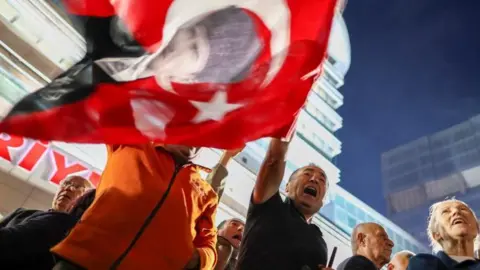
Turkish riot police stormed the CHP headquarters in Ankara after a court voided Özgür Özel's leadership and ordered Kemal Kilicdaroğlu to replace him, escalating Turkey's political crackdown. The ruling also replaces the party's entire executive and follows allegations of vote buying in the 2025 CHP primary. The confrontation underscores rising political risk and further consolidation of President Erdoğan's power.
The market implication is not an isolated “Turkey risk” headline; it is a signal that institutional checks are weakening in a way that raises the discount rate on every domestic Turkish asset. The first-order hit is to local equities and lira duration, but the second-order effect is more important: once political competition is being managed through the courts, capital allocators start assuming a higher probability of ad hoc policy shifts, FX intervention, and uneven enforcement on banks, corporates, and foreign investors. That typically shows up first in the front end of the curve and in liquid proxy names before it becomes obvious in macro data.
The near-term catalyst set is days to weeks, not months: protests, additional judicial moves against opposition structures, and any sign of broader administrative pressure on municipalities or media would extend the risk-off impulse. The tail risk is a self-reinforcing confidence shock where residents and local corporates accelerate dollarization, forcing tighter capital controls or more aggressive reserve use. That matters because the regime can stabilize optics for a while, but it cannot easily stabilize credibility once households and exporters decide they are no longer being paid to hold lira risk.
The contrarian angle is that the initial selloff in Türkiye exposure may be too broad if investors treat this as a clean macro short. The trade is likely better expressed through governance-sensitive financials and domestic-demand names than through exporters with natural FX hedges. A more interesting second-order beneficiary is any hard-currency issuer with low sovereign linkage and offshore revenue, because political stress can widen spreads indiscriminately and create entry points in credits that do not depend on local policy execution.
The main thing consensus may miss is timing: the biggest P&L opportunity is usually in the gap between headline repression and actual policy transmission. If the state keeps order without expanding the conflict, the move can partially retrace; if opposition mobilization broadens, the repricing can be abrupt and nonlinear. That makes options and pairs preferable to outright spot exposure here.
AI-powered research, real-time alerts, and portfolio analytics for institutional investors.
Request DemoOverall Sentiment
strongly negative
Sentiment Score
-0.60
