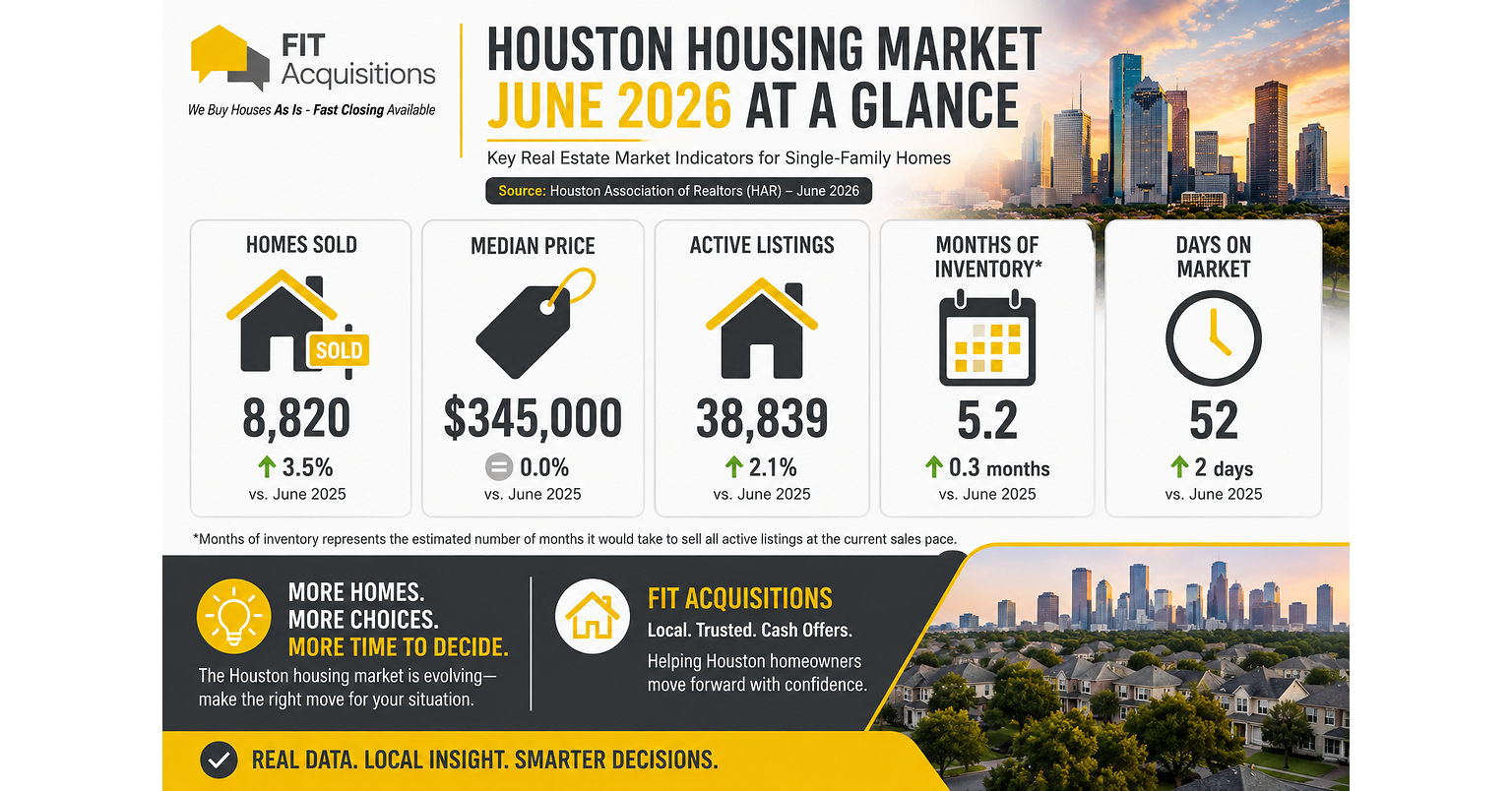
Houston’s June 2026 housing market showed buyer activity with single-family sales up 3.5% YoY to 8,820 and pending sales up 12.3% YoY, alongside a higher inventory backdrop with active listings rising 2.1% YoY to 38,839 and 5.2 months of inventory. Home values were relatively stable (median $345,000, ~flat YoY; average price up 1.2% to $455,159) while time on market lengthened slightly to 52 days from 50. The article frames the setup for 2027 sellers as “more buyer options” and emphasizes comparing net proceeds (after repairs, costs, and carrying expenses) rather than only headline offer price, with mortgage rates still influencing financed transactions.
This reads more like a local liquidity normalizing story than a macro housing turn. Higher inventory and longer marketing times usually shift economics toward buyers who can underwrite condition risk, which widens the opportunity set for cash buyers, distressed-asset investors, and contractors—but only if they can source deals at enough spread to cover repair inflation and resale risk. For public markets, the cleanest second-order effect is not on home prices but on transaction mix: more as-is sales, more concessions, and a higher share of lenders/escrows/title work tied to existing-home turnover.
The main loser is the marginal seller of dated or repair-heavy homes, because a slightly slower market disproportionately compresses their net proceeds. That tends to favor capitalized, process-driven buyers over small flippers, while making iBuying-style models and thin-margin wholesalers more vulnerable if spreads narrow faster than their bid models adjust. If this Houston pattern persists for 1-3 months, it is mildly positive for Home Depot (HD) / Lowe’s (LOW) through repair/prep spend, but the benefit is incremental, not thesis-changing.
Contrarian view: the market may be underestimating how much “stable prices” can coexist with softer seller leverage; if rates stay elevated, the real effect is a longer clearing process rather than an outright price break. The thesis breaks if mortgage rates fall enough to re-ignite bid competition or if inventory pushes decisively above ~6 months, which would turn this from a seller-selection story into a broader price-concession cycle. For now, the signal is too local and too small to justify a large directional housing trade.
AI-powered research, real-time alerts, and portfolio analytics for institutional investors.
Request DemoOverall Sentiment
neutral
Sentiment Score
0.05
Ticker Sentiment
