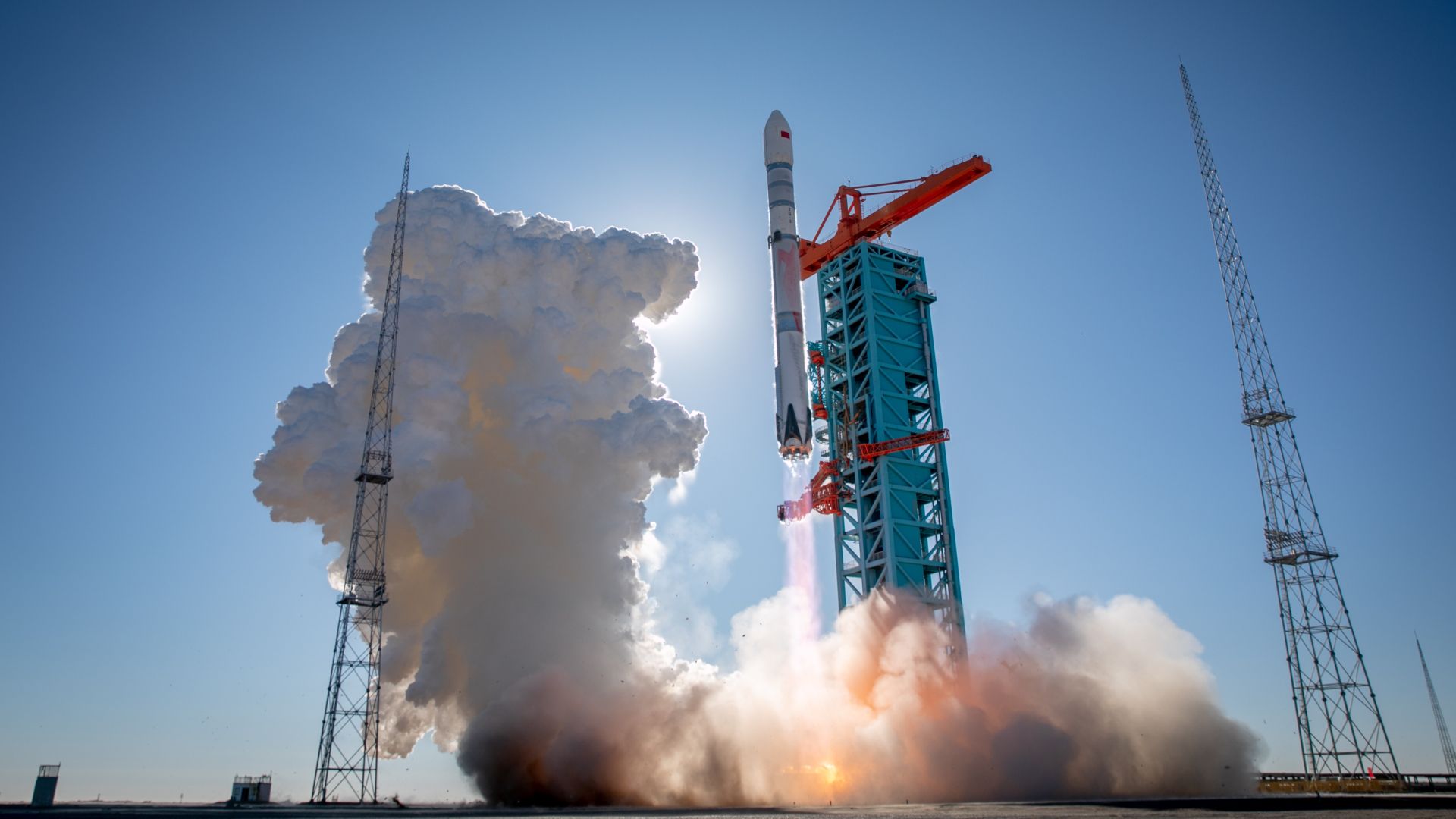
China posted a record year of space activity in 2025 with over 80 orbital launch attempts (surpassing the prior 68), successful long-running reliability of the Long March family, a partially successful commercial reusable-orbital debut (Landspace’s Zhuque 3 reached orbit but failed its first-stage landing), and plans for further reusable Long March 12A tests. Strategic initiatives include two >10,000-satellite megaconstellations (Guowang and Thousand Sails), a Tianwen 2 asteroid sample-return en route to Kamo'oalewa, an apparent GEO satellite refueling test, and completed contingency operations resolving China’s first human spaceflight emergency (Shenzhou 20 viewport crack) — developments that materially advance China’s sovereign and commercial space capabilities and merit attention from investors tracking aerospace, defense and related supply chains.
Market structure: China scaling to >80 launches/yr and state-backed 10k+ megaconstellations materially increases supply of LEO launch capacity and terminal services, benefitting satellite manufacturers, ground-station vendors, data analytics firms and domestic Chinese suppliers while pressuring pricing power for Western small-launch pure-plays. Expect downward pressure on per-satellite launch ASPs (potentially 20–40% over 2–3 years in commercial small-sat lanes) as China leverages scale, but rising demand for mass-produced smallsat buses and ground infra should lift component and services revenue.
Risk assessment: Tail risks include US/Allied export controls or sanctions (low probability, high impact) that could bifurcate supply chains, a major orbital debris collision (Kessler event) that could halt launches for months, or a PRC policy pivot away from commercial export markets. Immediate (days) market moves are likely muted; short-term (3–12 months) see re-rating on earnings guidance for launch OEMs; long-term (1–5 years) structural winners are diversified defense primes, satellite-data companies and ground infrastructure providers.
Trade implications: Favor diversified aerospace/defense exposure and satellite data/ground infra over single-mission launchers. Use LEAP calls or call spreads on satellite imagery/manufacturing names to capture multi-year secular demand, hedge or reduce exposure to standalone small-launch equities, and rotate into suppliers of helium, avionics and RF payloads. Time entries ahead of key catalysts (Long March 12A reusable demo, Chang'e 7 launch) within 3–9 months; size positions modestly (1–3% each).
Contrarian angles: Consensus fears of Western obsolescence may be overdone — state-backed Chinese capacity will initially serve domestic/state projects, not immediately undercut premium international commercial contracts; this keeps margins intact for specialized Western OEMs for 12–24 months. Historical parallel: early SpaceX price disruption took several years to compress incumbents' margins; expect a similar multi-year window to reposition rather than panic-sell, and watch for second-order impacts like increased demand for space insurance and debris mitigation technology.
AI-powered research, real-time alerts, and portfolio analytics for institutional investors.
Request DemoOverall Sentiment
mildly positive
Sentiment Score
0.32
